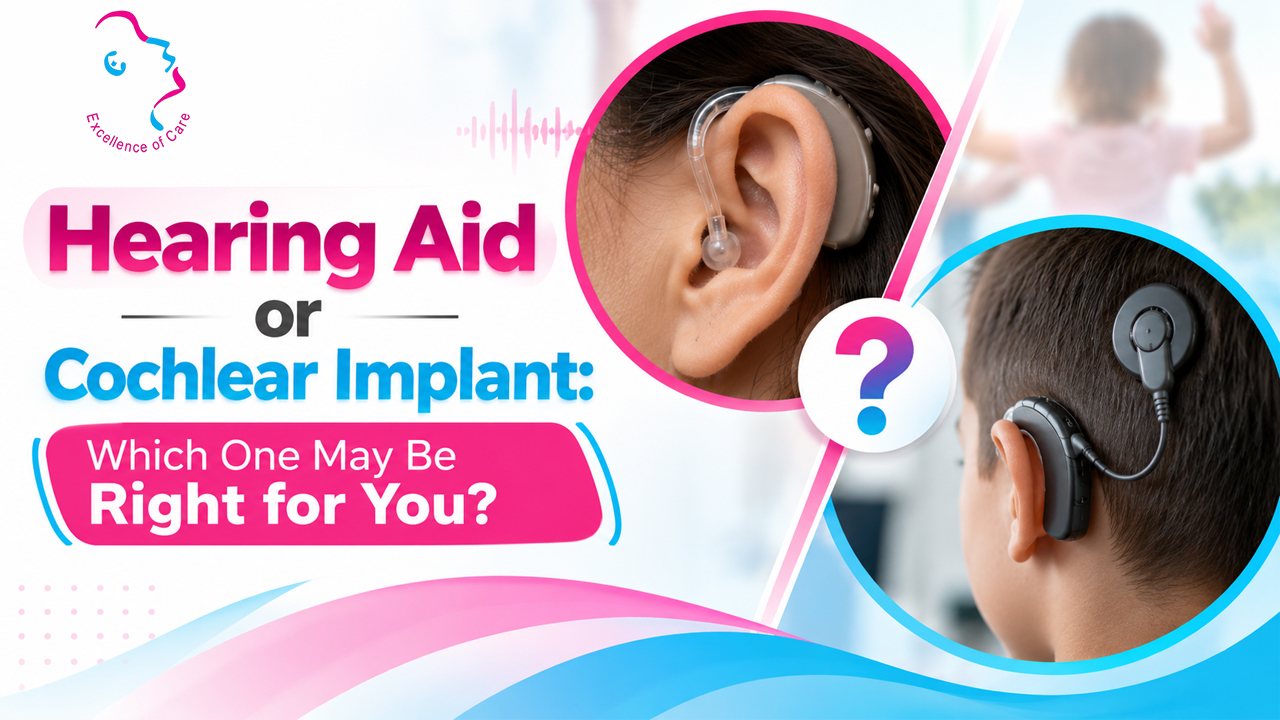
If someone in your family is struggling to hear, the honest first answer is this: a hearing aid is usually tried first, and it works well for most people with mild-to-severe hearing loss. A cochlear implant is a different kind of device a surgically placed medical implant that may be considered when hearing loss is severe to profound and hearing aids no longer provide enough benefit, even at their strongest settings. Neither option can be chosen from a description alone; the right one depends on a formal hearing evaluation.
This guide is written for adults noticing hearing changes, parents of children with confirmed or suspected hearing loss, and family members researching options for an aging parent in Kathmandu and across Nepal. It explains how each device actually works, who typically qualifies for each, what the evaluation process looks like, and the questions worth asking before deciding including where a hearing aid service in Nepal fits into that process.
What Is a Hearing Aid?
A hearing aid is a small electronic device, worn in or behind the ear, that makes sound louder and clearer so a person with hearing difficulty can detect and understand it more easily. It does not repair the ear it works with whatever hearing capacity remains.
A hearing aid typically has three parts: a microphone that picks up sound, a processor that amplifies and shapes that sound, and a small speaker (receiver) that delivers the amplified sound into the ear canal. Modern digital hearing aids can be programmed to amplify specific frequencies more than others, based on an individual's audiogram, and many include features like noise reduction, directional microphones, and Bluetooth streaming.
Hearing aids come in several styles, generally categorized by where they sit: behind-the-ear (BTE), in-the-ear (ITE), in-the-canal (ITC), completely-in-canal (CIC), and receiver-in-canal (RIC). Style choice depends on the degree of hearing loss, ear canal anatomy, dexterity, and personal preference, and is something an audiologist typically discusses during fitting.
Because a hearing aid depends on amplifying signals that the ear can still transmit, it is generally most effective when there is still usable residual hearing even if that hearing is significantly reduced.
What Is a Cochlear Implant?
A cochlear implant works on a completely different principle. Rather than amplifying sound for a damaged ear to pick up, it bypasses the damaged part of the inner ear (the cochlea) and directly stimulates the auditory nerve, which then sends signals to the brain to be interpreted as sound.
A cochlear implant system has two parts. An external sound processor, usually worn behind the ear, captures sound and converts it into a digital signal. This signal is transmitted through the skin to an internally implanted receiver and electrode array, surgically placed inside the cochlea during an ENT surgical procedure. The electrode array stimulates the auditory nerve directly, which is why a cochlear implant can help even when the tiny hair cells inside the cochlea are too damaged for a hearing aid's amplified sound to be useful.
Hearing through a cochlear implant is different from natural hearing and from hearing-aid-assisted hearing. It typically takes time, along with structured listening practice and often speech-language therapy, for the brain to learn to interpret these new signals as familiar sounds and speech.
Hearing Aid vs Cochlear Implant: Key Differences
| Factor | Hearing Aid | Cochlear Implant |
|---|---|---|
| How it works | Amplifies sound | Bypasses the damaged cochlea and directly stimulates the auditory nerve |
| Placement | Worn externally, non-surgical | Requires ENT surgery to implant the internal component |
| Typical candidacy | Mild to severe sensorineural hearing loss with usable residual hearing | Severe to profound sensorineural hearing loss with limited benefit from well-fitted hearing aids |
| Reversibility | Fully reversible; can be removed or changed anytime | Surgical procedure; the implanted component is generally permanent, though external processors can be upgraded |
| Adjustment period | Days to weeks of acclimatization | Weeks to months of auditory training and rehabilitation are often needed |
| Who's typically involved | Audiologist | ENT-head & neck surgeon plus audiologist and often a speech-language pathologist |
| Follow-up needs | Periodic re-fitting and maintenance | Surgical follow-up, device "mapping" (programming) sessions, and ongoing rehabilitation |
What this table means in practice: the deciding factor is not personal preference between "device A vs device B" it is how much usable hearing remains and how much benefit a properly fitted hearing aid actually provides on standardized testing. A hearing aid that is not helping enough is a clinical finding, not a guess, and it is the trigger for discussing cochlear implant candidacy.
Who May Benefit From a Hearing Aid
A hearing aid is generally considered appropriate first-line support for people who:
- Have mild to moderately severe (and in many cases severe) sensorineural hearing loss
- Still have measurable, usable hearing in the frequencies most important for understanding speech
- Report difficulty in specific situations group conversations, phone calls, television, or noisy environments rather than an inability to detect sound at all
- Are noticing gradual, age-related hearing changes (presbycusis) or hearing loss related to long-term noise exposure
- Have hearing loss affecting only one ear, or asymmetric loss, where amplification on the affected side can help balance hearing
Hearing aids are also frequently the starting point even for people whose hearing loss is more significant, because a properly fitted trial with modern amplification is typically part of how cochlear implant candidacy itself gets assessed.
Who May Be a Candidate for a Cochlear Implant
Cochlear implant candidacy is a clinical decision made by an ENT surgeon and audiologist together, generally based on a combination of factors rather than a single test result. Broadly, cochlear implants tend to be discussed for:
- Adults and children with severe to profound sensorineural hearing loss in both ears
- Individuals who receive little or no measurable benefit from appropriately fitted hearing aids this is usually confirmed with standardized aided speech-recognition testing, not just a subjective impression
- Young children with confirmed severe-to-profound hearing loss, where early intervention supports speech and language development; internationally, cochlear implants are FDA-approved from around 9–12 months of age in appropriate cases, though every child is evaluated individually
- Adults with progressive hearing loss who have "outgrown" the benefit their hearing aids once provided
- People with single-sided deafness or significantly asymmetric hearing loss, in select cases, following individualized evaluation
Candidacy also depends on general health and fitness for surgery, imaging findings of the inner ear and auditory nerve, and realistic expectations about the adjustment period. None of this can be determined from symptoms alone it requires a formal, in-person hearing and medical evaluation.
How the Evaluation Works
Deciding between a hearing aid and a cochlear implant is not something a patient or an article can determine alone. At a multidisciplinary ENT and audiology clinic, the process generally follows a structured path:
- Clinical history and ENT examination. The ENT specialist reviews the pattern of hearing loss, prior ear problems (like recurrent infections or eardrum issues), and general health, and examines the ear itself.
- Diagnostic hearing tests. Audiometry, and where relevant tympanometry, otoacoustic emissions (OAE), auditory brainstem response (ABR), or auditory steady-state response (ASSR) testing, map out the type and degree of hearing loss.
- Hearing aid trial and aided testing, when appropriate. For candidates who are not already using hearing aids, a properly fitted trial is often used to measure real-world benefit through aided speech-recognition scores this is frequently the step that clarifies whether amplification is enough.
- Cochlear implant work-up, if indicated. When aided benefit remains limited, further evaluation which can include imaging of the inner ear and auditory nerve, and counseling on realistic outcomes and rehabilitation commitment determines surgical candidacy.
- Shared decision-making. The ENT surgeons and audiologists at ENT Care Center explain findings, options, and what to expect, so the patient or family can make an informed decision rather than being told what to choose.
- Fitting, surgery, or both followed by rehabilitation. Hearing aid fitting is adjusted over several visits; cochlear implant surgery is followed by device activation, mapping sessions, and often speech-language therapy to build listening skills.
Benefits and Limitations of Hearing Aids
Benefits: non-surgical, adjustable and reversible, available in a range of styles and price points, can often be trialed before committing, and modern devices increasingly offer noise reduction and connectivity features.
Limitations: hearing aids amplify sound but cannot restore hearing that the ear can no longer transmit at all; benefit is typically more limited in loud or crowded environments; and for severe-to-profound hearing loss, amplification alone may not be enough to support clear speech understanding, even with the best-fitted device.
Benefits and Limitations of Cochlear Implants
Benefits: can restore access to sound for people who get little or no benefit from hearing aids, is often associated with meaningful improvement in speech understanding for appropriate candidates, and is particularly time-sensitive and valuable for young children with confirmed severe-to-profound hearing loss, supporting speech and language development.
Limitations: it requires a surgical procedure with the general risks that come with any ear surgery and anesthesia; the sound produced is different from natural hearing and generally requires an adjustment period with auditory training; ongoing follow-up for device programming is needed; and in some cases, cochlear implant surgery can reduce any remaining natural (acoustic) hearing in the implanted ear — which is one of several reasons careful pre-surgical testing matters.
Common Mistakes and Misconceptions
- "A cochlear implant is just a stronger hearing aid." It is not it uses a completely different mechanism (electrical stimulation of the auditory nerve versus sound amplification) and is only appropriate for a specific category of hearing loss.
- "If a hearing aid isn't helping, buying a more expensive one will fix it." Beyond a certain degree of hearing loss, no amount of amplification substitutes for a cochlear implant evaluation; the issue is not aid quality but the ear's remaining capacity to use amplified sound.
- "Waiting a bit longer won't matter." For children with confirmed severe-to-profound hearing loss, timing genuinely affects speech and language development outcomes, which is why early evaluation matters.
- "A cochlear implant restores hearing exactly like it was before." Cochlear implant hearing is different from natural hearing and is typically learned over time through practice and, often, therapy.
- "Online hearing loss self-tests are enough to decide." They can flag a concern, but candidacy decisions require in-person diagnostic testing and clinical evaluation.
Cost and Practical Considerations in Nepal
Cost, insurance coverage, and device availability vary by provider, device brand, and individual circumstances, so this article does not quote fixed prices those should be confirmed directly with the clinic during a consultation. A few practical points are still useful to plan around:
- Hearing aids generally involve an upfront device cost plus ongoing costs for batteries, maintenance, and periodic reprogramming as hearing needs change.
- Cochlear implants involve surgical and hospital costs in addition to the device itself, plus the ongoing commitment to mapping visits and rehabilitation sessions.
- Both pathways benefit from planning around follow-up visits hearing aid fitting is rarely a single appointment, and cochlear implant rehabilitation is a multi-visit process, not a one-time event.
- Distance and travel time to a clinic matter for follow-up-heavy pathways; discussing a realistic visit schedule during the first consultation helps set expectations.
For families weighing options, it is reasonable to contact the clinic team directly to ask what a realistic visit and follow-up schedule would look like before deciding.
How to Choose: A Decision Checklist
Use this as a starting point for the conversation with your ENT specialist and audiologist, not as a self-diagnosis tool:
- Has a formal audiometric hearing test been done, and what degree and type of hearing loss did it show?
- If hearing aids have already been tried, were aided speech-recognition scores measured and how much real-world benefit is the person getting?
- Is the hearing loss in one ear or both, and is it stable or progressing?
- For a child: is there a delay in speech or language development that could be linked to hearing loss?
- Are there other ear or medical conditions (like chronic infection or a perforated eardrum) that need treatment first?
- What does the evaluating ENT surgeon and audiologist recommend as next steps, and why?
- What does a realistic timeline look like for fitting, surgery (if relevant), and rehabilitation?
When to See a Specialist
If hearing difficulty is affecting conversations, work, school, or safety or if a child is not responding consistently to sound or is showing delayed speech that is a reasonable point to see an ENT specialist rather than waiting. Sudden hearing loss (over hours to a few days), hearing loss with dizziness, or hearing loss following an ear infection or injury generally warrants prompt evaluation rather than a "wait and see" approach.
Frequently Asked Questions
Is a cochlear implant better than a hearing aid?
Neither is universally "better" they serve different degrees and types of hearing loss. A hearing aid is generally suited to mild-to-severe hearing loss with usable residual hearing, while a cochlear implant is considered for severe-to-profound hearing loss when hearing aids no longer provide enough benefit. The right choice depends on individual test results, not personal preference alone.
Can a hearing aid stop working for severe hearing loss?
A hearing aid does not "stop working" in a technical sense, but it can become insufficient as hearing loss progresses, because amplification depends on the ear still being able to use the sound it receives. When aided benefit on speech-recognition testing becomes very limited, that is usually the point at which cochlear implant evaluation is discussed.
At what age can a child get a cochlear implant?
Internationally, cochlear implants are approved for children as young as around 9–12 months in appropriate cases of confirmed severe-to-profound hearing loss, though every child's candidacy is assessed individually by the evaluating team. Earlier evaluation generally allows earlier decision-making, which can matter for speech and language development.
Does getting a cochlear implant mean losing all remaining natural hearing?
Not necessarily, but it is a real consideration. Cochlear implant surgery can reduce or, in some cases, eliminate any remaining natural (acoustic) hearing in the implanted ear, which is one reason pre-surgical testing and counseling are an important part of the evaluation, not a formality.
How long does it take to adjust to a cochlear implant?
Adjustment varies by person, prior hearing history, and age at implantation, but it commonly takes weeks to months of structured listening practice, and often speech-language therapy, for sound through the implant to become clear and familiar. This is different from a hearing aid, which typically requires a shorter acclimatization period.
Where can I get a hearing evaluation in Kathmandu?
A hearing evaluation for either pathway should be done by a qualified audiologist alongside an ENT specialist, since the decision involves both hearing testing and medical assessment of the ear. ENT Care Center in Kathmandu offers hearing assessment, hearing aid consultation, and cochlear implant consultation as part of one coordinated evaluation.
Do I need a hearing aid trial before being considered for a cochlear implant?
In most cases, yes, a properly fitted hearing aid trial with measured aided benefit is typically part of how cochlear implant candidacy is established, except in specific situations (such as certain young children or particular medical circumstances) where the evaluating team may proceed differently.
Key Takeaways
- A hearing aid amplifies sound and is generally the first option considered for mild-to-severe sensorineural hearing loss.
- A cochlear implant is a surgically placed device that bypasses the damaged cochlea and directly stimulates the auditory nerve, typically considered for severe-to-profound hearing loss with limited benefit from hearing aids.
- Candidacy for either option is determined through formal audiometric testing and clinical evaluation not through self-assessment.
- Cochlear implant surgery carries real trade-offs, including possible loss of remaining natural hearing in the implanted ear, and a rehabilitation period is part of the process for both children and adults.
- Waiting can matter, particularly for children with confirmed severe-to-profound hearing loss.
Ready for the Next Step?
If hearing difficulty is affecting daily life yours or a family member's the most useful next step is a proper hearing evaluation, not guessing between devices from an article. Book a hearing evaluation with ENT Care Center's ENT surgeons and audiologists in Kathmandu to get a clear, individualized answer about whether a hearing aid, a cochlear implant, or further testing is the right next step for you.