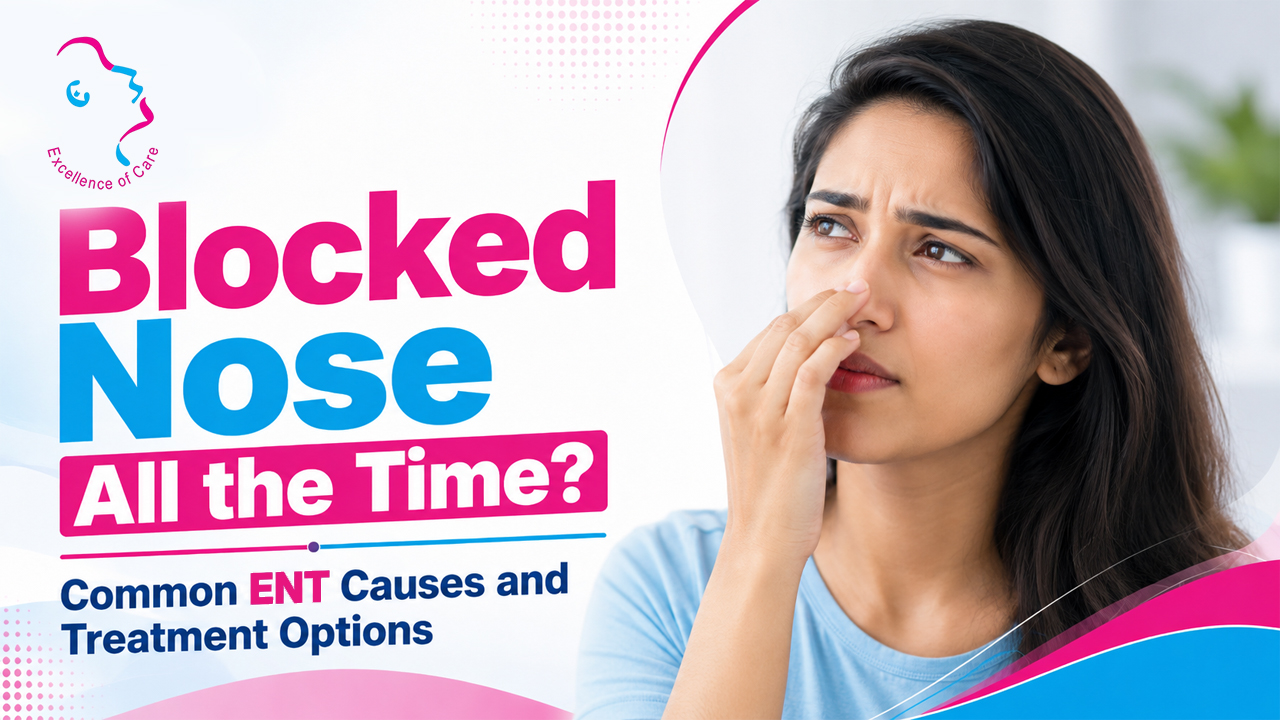
A blocked nose that lasts for more than a few days is not always “just a cold.” Persistent nasal blockage may be caused by allergies, sinus inflammation, swollen nasal tissues, a deviated septum, enlarged turbinates, nasal polyps or, in children, enlarged adenoids. The appropriate blocked nose treatment depends on which of these problems is restricting airflow.
Temporary self-care may improve mild congestion, but recurring, one-sided or long-lasting blockage should be properly assessed, especially when it affects sleep, smell, exercise or normal breathing. ENT Care Center provides nasal blockage evaluation and treatment in Kathmandu for inflammatory and structural nasal conditions.
This article explains the common causes, nighttime patterns, safe relief measures, diagnostic process and situations in which an ENT consultation may be appropriate.
Medical note: This information is educational and does not diagnose an individual condition or replace an examination by a qualified healthcare professional.
What does having a blocked nose actually mean?
A blocked nose usually develops when the tissue lining the nasal passages becomes inflamed and swollen. Excess mucus may add to the feeling of obstruction, but mucus is not always the main problem. A person may feel severely congested even when very little discharge is present because swollen blood vessels and nasal tissues have reduced the space available for airflow.
Nasal blockage can also result from a physical narrowing or obstruction. Examples include a bent nasal septum, enlarged turbinates, nasal polyps, scar tissue or, less commonly, another growth or a foreign object.
This distinction matters:
- Inflammatory blockage may improve when the inflammation or allergy is controlled.
- Structural blockage may continue even when cold or allergy symptoms have settled.
- Mixed blockage occurs when a structural narrowing and inflammation are both present.
The sensation can affect one nostril, alternate between nostrils or involve both sides. How long it has lasted, whether it changes sides and which other symptoms occur provide useful clues, but an examination is sometimes required to identify the cause.
What are the most common causes of a blocked nose?
The most common causes include viral respiratory infections, allergic or non-allergic rhinitis, sinusitis, a deviated nasal septum, enlarged turbinates and nasal polyps. Children may also develop persistent blockage from enlarged adenoids or an object placed inside one nostril.
1. A cold or another viral respiratory infection
A common cold often causes a blocked or runny nose, sneezing, sore throat and cough. Congestion caused by a straightforward viral infection generally improves as the infection settles. Rhinovirus symptoms commonly last less than seven days, although they can continue for up to two weeks.
A viral infection becomes less likely to be the only cause when:
- The nose remains blocked for several weeks.
- Symptoms repeatedly return.
- One nostril is consistently worse.
- Nasal breathing never returns to normal between infections.
- There is continuing loss of smell.
- Symptoms strongly follow dust, pollen, smoke or weather exposure.
A cold can temporarily worsen an existing allergy, septal deviation or turbinate problem. This explains why some people continue feeling obstructed after their fever, sore throat and body discomfort have improved.
2. Allergic rhinitis
Allergic rhinitis develops when the nasal lining reacts to an allergen. Common symptoms include repeated sneezing, an itchy nose, clear watery discharge, watery or itchy eyes and a blocked nose. Possible triggers include pollen, house-dust mites, mould, animal dander and certain occupational exposures.
Allergy becomes more likely when symptoms:
- Begin soon after exposure to a trigger.
- Occur during particular seasons.
- Are worse while cleaning dusty rooms.
- Develop in certain buildings or bedrooms.
- Include nasal itching and repeated sneezing.
- Improve when the person is away from the suspected environment.
Kathmandu residents may encounter combinations of dust, smoke, traffic-related irritants and indoor allergens. These exposures do not prove that someone has an allergy, but they can aggravate an already sensitive nasal lining.
People with recurring trigger-related symptoms can consider professional allergy testing and treatment. The evaluation should determine whether the symptoms fit allergic rhinitis, non-allergic irritation, sinus disease or another nasal condition.
3. Non-allergic rhinitis
Non-allergic rhinitis causes congestion or a runny nose without a typical allergic reaction. The nasal lining may respond to smoke, perfume, paint fumes, changes in temperature or humidity, exercise, hormonal changes, spicy food or certain medicines.
Unlike allergic rhinitis, non-allergic rhinitis may not cause intense itching or watery eyes. Some people have mixed rhinitis, meaning that both allergic and non-allergic triggers contribute.
A useful clue is consistency: a person may notice congestion around strong fragrances, cooking fumes, pollution, cold air or rapid weather changes even when allergy testing does not identify a clear allergen.
Treatment focuses on identifying the trigger pattern and controlling nasal inflammation. Repeatedly using quick-relief sprays without understanding the cause can make long-term management more difficult.
4. Sinusitis or chronic rhinosinusitis
Sinusitis occurs when the tissue lining the sinuses becomes inflamed or swollen. It may cause nasal blockage, thick discharge, post-nasal drip, reduced smell, facial pressure, headache and cough. A deviated septum or nasal polyp may also interfere with sinus drainage.
Not every blocked nose with a headache is sinusitis. The symptom pattern is more suggestive when congestion occurs with:
- Pressure or tenderness around the cheeks, eyes or forehead
- Thick or discoloured discharge
- Reduced sense of smell
- Post-nasal mucus
- Symptoms that initially improve and then worsen
- Repeated similar episodes
- Symptoms that continue for an extended period
The CDC advises medical assessment when sinus symptoms are severe, worsen after initially improving, continue for more than 10 days without improvement, involve fever lasting more than three to four days or recur several times in a year.
ENT Care Center, an ENT clinic based in Kathmandu, offers sinus evaluation and treatment for persistent blockage, sinus pressure, discharge, post-nasal drip, reduced smell and recurring sinus symptoms.
5. A deviated nasal septum
The nasal septum is the wall separating the two sides of the nose. When it is significantly bent or displaced, one side may have less space for airflow. The person may notice constant one-sided blockage, mouth breathing, snoring, repeated sinus symptoms, nosebleeds or difficulty breathing during exercise.
A mild septal deviation does not always cause symptoms. The relevant question is not simply whether the septum looks uneven, but whether it significantly restricts airflow or contributes to recurring problems.
The nasal cycle can make this more noticeable. It is normal for airflow to alternate somewhat between the two nostrils. A person with a narrow side may become much more aware of the normal cycle because the already restricted passage feels almost completely blocked when its lining naturally swells.
Medicines may help if allergy or rhinitis is adding inflammation, but medicine cannot physically straighten a septum. People with continuing one-sided obstruction can read about deviated nasal septum evaluation.
6. Enlarged turbinates
Turbinates are structures along the side walls of the nose. They help warm, humidify and filter inhaled air. Their soft tissue can swell because of allergy, infection, irritant exposure or chronic rhinitis.
Enlarged turbinates may cause blockage on both sides or congestion that alternates. Symptoms often fluctuate more than they would with a fixed septal obstruction.
An ENT examination may show whether turbinate swelling is the main problem, whether a septal deviation is also present and whether the tissues respond to appropriate medical treatment. In selected patients whose obstruction continues despite medical management, a specialist may discuss turbinate procedures. The American Academy of Otolaryngology–Head and Neck Surgery notes that turbinate reduction may be considered in patients with allergic rhinitis, nasal obstruction and enlarged inferior turbinates when medical management has failed.
7. Nasal polyps
Nasal polyps are soft, non-cancerous inflammatory growths that develop in the nasal passages or sinuses. They may cause a constantly blocked nose, reduced or lost sense of smell, snoring, post-nasal drip and recurring sinus problems. People sometimes describe the sensation as having a cold that never completely clears.
Small polyps may cause few symptoms. Larger or multiple polyps may significantly restrict airflow and sinus drainage.
Treatment depends on the extent of the polyps, the severity of symptoms and the presence of related sinus or allergy inflammation. Medical treatment may reduce inflammation, while surgery may be discussed for selected patients with large, recurrent or significantly obstructive polyps. ENT Care Center has a dedicated page on nasal polyp evaluation and treatment.
8. Enlarged adenoids or other causes in children
Children may develop persistent nasal obstruction because of repeated infections, allergies, enlarged adenoids or an object placed inside the nose. Enlarged adenoids may contribute to mouth breathing, snoring, restless sleep and a persistently nasal-sounding voice.
A foul-smelling discharge or blockage affecting only one nostril in a young child raises concern about a nasal foreign object. Parents should not attempt blind removal with cotton buds, tweezers or other tools because the object may be pushed deeper.
Persistent mouth breathing, loud snoring, pauses in breathing, feeding difficulty, reduced hearing or repeated ear problems also deserve professional assessment.
9. Overuse of decongestant nasal spray
Some decongestant sprays provide rapid short-term relief by reducing swelling in nasal blood vessels. However, using them for longer than the recommended period can lead to worsening congestion when their effect wears off. This is often called rebound congestion.
NHS guidance warns that decongestant nasal sprays and drops should not be used for longer than about one week because prolonged use can worsen stuffiness. Product limits vary, so users should follow the label and obtain advice from a pharmacist or doctor.
People who feel unable to breathe without repeatedly using a quick-relief spray should seek professional guidance rather than simply increasing the amount or frequency.
What can the pattern of your symptoms suggest?
The following table is a decision aid, not a diagnosis.
| Symptom pattern | Possible explanation | Appropriate next step |
|---|---|---|
| Blockage with sneezing, itching and watery eyes | Allergic rhinitis | Identify triggers and consider allergy assessment |
| Blockage around smoke, perfume or changing weather | Non-allergic rhinitis | Reduce irritant exposure and discuss persistent symptoms |
| Thick discharge with facial pressure | Sinus inflammation or infection | Seek assessment if severe, worsening or prolonged |
| One side blocked most of the time | Septal deviation or another local obstruction | Arrange an ENT examination |
| Constant blockage with reduced smell | Polyps or chronic sinus inflammation | Consider endoscopic nasal assessment |
| Blockage that changes when turning in bed | Positional swelling or the nasal cycle | Elevate the head; assess if frequent or disruptive |
| Congestion after repeated spray use | Rebound congestion | Obtain pharmacist or medical advice |
| Child with one-sided foul-smelling discharge | Possible nasal foreign body | Prompt ENT assessment |
| Blockage with loud snoring or breathing pauses | Upper-airway or sleep-related obstruction | ENT and sleep-related evaluation |
| One-sided blockage with repeated bleeding | Structural lesion or another nasal abnormality | Timely ENT examination |
The duration and consistency of symptoms are particularly important. A short episode associated with a cold is different from obstruction that returns every night, persists between infections or remains limited to one side.
Why is a blocked nose often worse at night?
A blocked nose may feel worse at night because lying down changes blood flow and nasal tissue swelling, reduces the assistance of gravity in mucus drainage and makes the normal nasal cycle more noticeable. Bedroom allergens, dry air and an untreated structural narrowing may add to the problem.
Research on nasal patency has found that body position can affect the openness of the nasal passages, with lying positions producing measurable changes compared with sitting upright.
Several patterns may occur:
Lying flat
When a person lies flat, swollen tissue and mucus may produce a stronger sensation of congestion than when the person is upright. Elevating the head and upper body may provide temporary comfort for some people.
Sleeping on one side
The nostril closest to the mattress may feel more blocked while the upper nostril feels clearer. Turning over can sometimes reverse the sensation. This positional effect does not identify the underlying condition and does not correct a septal deviation, polyp or chronic inflammation.
Bedroom allergens
Dust mites, mould, animal dander or pollen on bedding can aggravate allergic rhinitis. Congestion that is much worse in a particular bedroom, during cleaning or after handling blankets may justify a closer review of possible triggers.
Dry or irritating air
Dry air can irritate nasal tissue, while smoke, incense, fragrances and indoor pollution may worsen non-allergic rhinitis. The goal is comfortable humidity rather than making the room excessively damp, which could encourage mould.
Existing structural narrowing
A person with a deviated septum, enlarged turbinates or polyps may notice a mild obstruction much more strongly when lying down. Nighttime symptoms can therefore reveal a problem that is less obvious during daytime activity.
How can you obtain temporary relief safely?
The safest immediate measures depend on the cause. Temporary relief should not replace evaluation when the nose remains blocked, repeatedly returns or is associated with warning signs.
Use a saline spray or rinse correctly
A saline nasal spray may help moisturize irritated passages and loosen mucus. A larger-volume nasal rinse may also remove mucus and allergens for some people.
Use only water that is distilled, sterile or appropriately boiled and cooled for nasal rinsing. The CDC warns against using unsafe tap water for sinus or nasal irrigation because contaminated water can rarely introduce serious infections. Clean and dry the irrigation device as directed.
People with recent nasal surgery, complete obstruction, significant nosebleeding or another medical concern should ask their clinician before beginning irrigation.
Maintain hydration
Drinking adequate fluids may help keep mucus less thick and easier to clear. Warm non-alcoholic drinks may also feel soothing when congestion occurs with a sore throat or cold.
Try comfortable humidity
A clean cool-mist humidifier may help when indoor air is dry. The device should be cleaned regularly because poorly maintained humidifiers can spread mould or microorganisms.
A warm shower may provide temporary comfort. Avoid inhaling very hot steam or placing the face close to boiling water, as this can cause burns.
Elevate the head during sleep
Raising the head and upper body rather than lying completely flat may improve comfort and mucus drainage for some people. Use a stable sleeping arrangement that supports the neck rather than stacking pillows in a way that causes strain.
Reduce identifiable triggers
When congestion is clearly associated with dust, smoke, fragrance or a specific room:
- Keep bedding clean and dry.
- Reduce indoor smoke and incense.
- Avoid direct exposure to strong chemical fumes.
- Address visible dampness or mould.
- Wear appropriate protection during dusty occupational tasks.
Avoid allowing pets to sleep on the bed when animal dander is a suspected trigger.
Trigger reduction helps most when it is based on a repeatable symptom pattern rather than a random list of restrictions.
Use medicines carefully
Antihistamines, anti-inflammatory nasal sprays and decongestants serve different purposes. The correct choice depends on whether the cause is allergic, inflammatory, infectious or structural.
Some nasal corticosteroid medicines are used for allergic rhinitis or chronic rhinosinusitis, but they must be used according to product instructions or a clinician’s advice and do not provide the same immediate sensation as a decongestant.
Decongestants may not be suitable for everyone, including some people with cardiovascular conditions, pregnancy, medication interactions or age-related restrictions. Obtain advice from a pharmacist or doctor rather than combining multiple cold products.
Do not begin antibiotics simply because mucus has changed colour. Antibiotics do not treat viral colds, allergies, septal deviation or nasal polyps. A clinician should determine whether a bacterial infection is likely.
How does an ENT specialist diagnose persistent nasal blockage?
An ENT assessment begins by identifying the pattern of obstruction, not by automatically ordering a scan or recommending surgery.
1. Symptom history
The clinician may ask:
- When did the blockage begin?
- Is it constant or intermittent?
- Does it affect one side or both?
- Does it switch sides?
- Is it worse at night, in particular rooms or during certain seasons?
- Are sneezing, itching, discharge or watery eyes present?
- Has the sense of smell changed?
- Is there facial pressure or post-nasal drip?
- Does the person snore or breathe through the mouth?
- Which sprays or medicines have already been used?
- Was there previous nasal injury or surgery?
These questions help separate allergic, inflammatory, infectious, structural and sleep-related patterns.
2. Routine ENT examination
The specialist examines the front of the nose, the nasal septum and visible mucosal tissue. The throat and related airway structures may also be examined, particularly when mouth breathing, snoring or post-nasal drip is present.
3. Nasal endoscopy when clinically indicated
A routine examination cannot always show the deeper nasal cavity or sinus drainage pathways. Diagnostic nasal endoscopy uses a thin rigid or flexible camera to examine the nasal passages, septum, turbinates, sinus openings and the area behind the nose. It may help identify inflammation, polyps, structural narrowing, discharge, crusting, foreign objects or abnormal tissue.
Endoscopy is not necessary for every temporary blocked nose. It is more relevant when symptoms are persistent, recurrent, unexplained, one-sided or unresponsive to initial treatment.
4. Allergy assessment
An allergy-focused history may be sufficient in some cases. Testing may be considered when the diagnosis is uncertain, symptoms remain uncontrolled or identifying a specific allergen would change the management plan.
5. Imaging in selected cases
A CT scan may be useful when deeper sinus anatomy, chronic sinus disease, surgical planning or a complication needs assessment. Imaging is not routinely needed for every uncomplicated short-term sinus episode.
What blocked nose treatments may be recommended?
Treatment should match the cause rather than the intensity of the symptom alone.
| Underlying problem | Possible treatment approach | Important limitation |
|---|---|---|
| Viral cold | Supportive care, hydration, saline and symptom monitoring | Antibiotics do not treat a viral cold |
| Allergic rhinitis | Trigger management, appropriate antihistamine or nasal anti-inflammatory therapy | Control may require regular use rather than occasional rescue treatment |
| Non-allergic rhinitis | Irritant avoidance and cause-specific nasal treatment | Allergy medication alone may not address all triggers |
| Acute sinus symptoms | Supportive care and clinical review when severe or prolonged | Not every sinus episode needs antibiotics or imaging |
| Chronic sinusitis | Nasal care, anti-inflammatory treatment, evaluation of polyps or drainage | Treatment depends on objective findings and duration |
| Deviated septum | Control associated inflammation; septoplasty may be discussed for significant obstruction | Medicines cannot straighten the septum |
| Enlarged turbinates | Medical treatment first; reduction procedure in selected cases | Procedures are not first-line for every patient |
| Nasal polyps | Anti-inflammatory treatment, follow-up and surgery in selected cases | Polyps may recur and often need long-term management |
| Enlarged adenoids | Pediatric ENT assessment and cause-based management | Surgery is not automatically needed for every child |
| Rebound congestion | Supervised withdrawal plan and management of the original cause | Repeated decongestant use may perpetuate symptoms |
Medical treatment
Medical treatment may include saline care, allergy control, antihistamines, anti-inflammatory nasal sprays or other cause-specific medicines. Selection should take account of age, pregnancy, other illnesses, current medicines and previous response.
The objective is not merely to create a temporary sensation of openness. It is to control the inflammation or trigger causing the obstruction.
Septoplasty
Septoplasty is a surgical procedure used to correct a nasal septum that significantly obstructs airflow. It may be discussed when symptoms remain troublesome and examination confirms that the septal deviation is an important cause.
Septoplasty is not a treatment for every blocked nose. A person whose main problem is uncontrolled allergy may continue experiencing congestion unless the inflammatory condition is also managed.
Turbinate treatment
When enlarged turbinates continue to obstruct breathing despite suitable medical treatment, a specialist may discuss a procedure intended to reduce their volume while preserving normal nasal function.
The expected benefit, possible risks and alternatives should be explained before any procedure.
Nasal polyp or sinus surgery
Surgery may be considered when polyps or chronic sinus disease produce significant symptoms that have not improved sufficiently with appropriate medical management. Treatment planning may include endoscopy and imaging.
Surgery improves access and removes obstruction, but continuing inflammatory or allergy management may still be needed afterward.
When should you see an ENT for a blocked nose?
Arrange an ENT assessment when the nose remains blocked for weeks, frequently returns, affects sleep or smell, causes ongoing mouth breathing or stays consistently worse on one side.
You should also seek medical care when:
- Symptoms last more than 10 days without improving.
- Symptoms improve and then become worse.
- Facial pain or headache is severe.
- Fever continues for several days.
- There are repeated sinus episodes.
- Snoring is accompanied by choking, gasping or pauses in breathing.
- A child has persistent mouth breathing or one-sided foul-smelling discharge.
- Nasal spray use has become frequent or difficult to stop.
- Blockage is associated with repeated nosebleeds.
- There is unexplained one-sided discharge or swelling.
Seek urgent care for significant difficulty breathing, confusion, severe rapidly worsening symptoms or other signs of serious illness.
Persistent symptoms can be assessed through an ENT specialist consultation in Kathmandu. The purpose of the consultation is to establish whether the blockage is inflammatory, infectious, structural or mixed before recommending treatment.
Questions worth asking during your ENT appointment
Consider asking:
- Is the blockage caused mainly by inflammation, structural narrowing or both?
- Does the symptom pattern suggest allergy?
- Is a deviated septum actually restricting airflow?
- Are the turbinates enlarged?
- Is nasal endoscopy necessary?
- Are polyps or chronic sinus inflammation present?
- Which treatment addresses the cause rather than providing only temporary relief?
- How long should treatment be tried before reviewing the response?
- What side effects or usage errors should be avoided?
- Under what circumstances would a procedure become appropriate?
Clear answers to these questions help patients understand why a treatment has been recommended and how success will be evaluated.
Key takeaways
A blocked nose is usually caused by swollen nasal tissue, excess mucus, structural narrowing or a combination of these factors.
- A cold is only one possible cause.
- Sneezing and itching suggest allergy, while persistent one-sided blockage raises more concern about a structural problem.
- Facial pressure, thick discharge and reduced smell may occur with sinus disease.
- Nighttime congestion may worsen because of posture, the nasal cycle, bedroom allergens or an existing narrowing.
- Saline, hydration, comfortable humidity and head elevation may provide temporary relief.
- Decongestant sprays should not be used beyond their recommended period.
- Long-lasting, recurring, one-sided or sleep-disrupting blockage deserves proper assessment.
- Treatment is most effective when it addresses the identified cause.
ENT Care Center evaluates nasal blockage, allergies, sinus conditions, septal deviation, polyps and related sleep symptoms at its Kathmandu clinic. To discuss persistent symptoms, request an ENT appointment.
Content review date: 19 July 2026
Clinical review status: Reviewed by ENT Specialist of ENT Care Center.