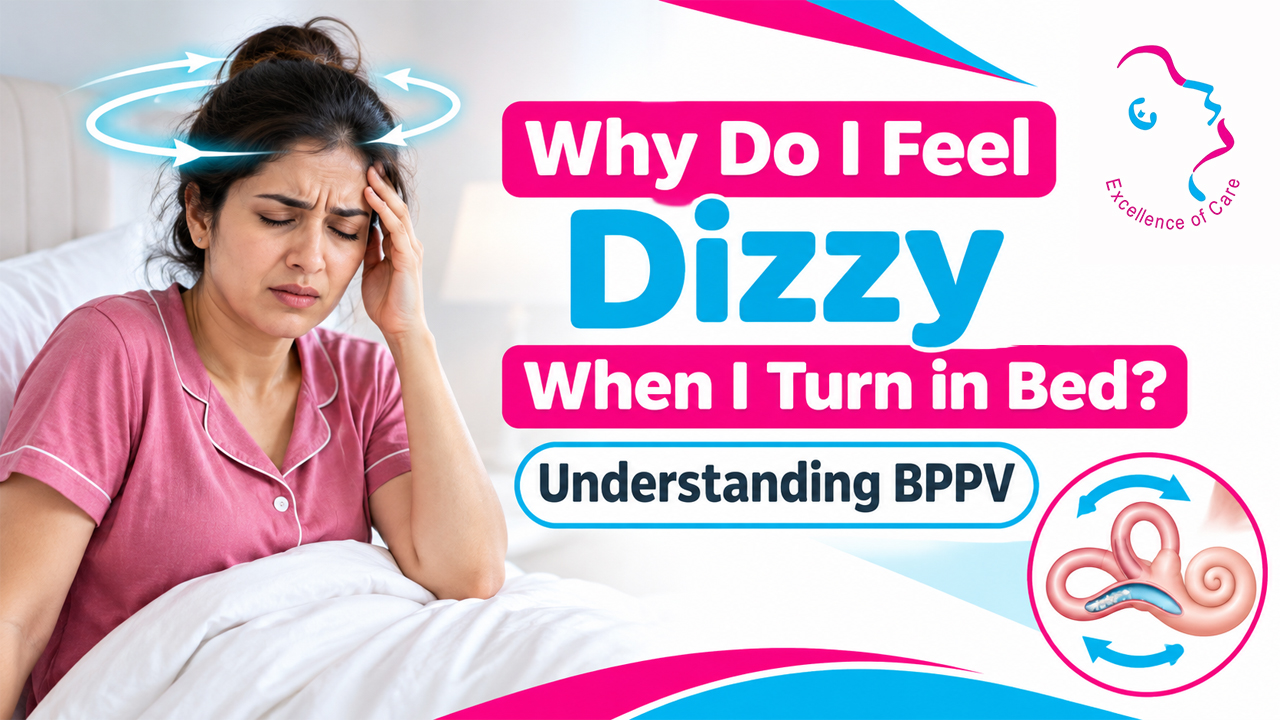
Have you ever turned over in bed and suddenly felt as though the entire room was spinning? You may have been lying comfortably, but one small movement of your head made everything feel unstable. The spinning might have lasted only a few seconds before settling down.
One common explanation is benign paroxysmal positional vertigo (BPPV), an inner-ear balance disorder that causes brief episodes of vertigo when the head moves into certain positions.
BPPV can occur when tiny calcium carbonate particles in the inner ear become displaced. These particles interfere with the normal signals that tell your brain how your head is moving.
However, not everyone who feels dizzy in bed has BPPV. Other medical conditions can produce similar symptoms, so understanding the pattern of dizziness is important.
This guide explains why turning in bed may trigger vertigo, how BPPV is diagnosed and treated, what you can do safely, and when professional medical evaluation is necessary.
Why Does Turning in Bed Make You Feel Dizzy?
If you experience a sudden spinning sensation when rolling from one side to another, lying back, or sitting up in bed, BPPV is one possible cause.
Your inner ear contains a balance system that detects head movement and helps your brain maintain orientation. In BPPV, displaced particles inside this system can produce an incorrect sensation of movement.
For example, you may turn toward your left side while sleeping and suddenly feel that the room is rotating. The sensation may stop after you remain still, only to return when you roll over again.
Typical BPPV attacks last less than a minute, although nausea or mild unsteadiness may persist afterward. The National Institute on Deafness and Other Communication Disorders' explanation of balance disorders identifies rolling over in bed as a characteristic trigger.
This pattern provides an important diagnostic clue, but it does not prove that BPPV is the cause.
What Is BPPV?
BPPV stands for benign paroxysmal positional vertigo.
The medical terminology describes the condition:
Benign: The condition is generally not caused by a dangerous underlying disease.
Paroxysmal: Symptoms occur in sudden episodes rather than remaining continuously present.
Positional: Certain changes in head position trigger the symptoms.
Vertigo: You experience a false sensation of movement, commonly spinning.
BPPV is a mechanical problem affecting the inner ear's balance system. Although it is usually not dangerous in itself, sudden vertigo can cause falls and disrupt everyday activities.
How the inner ear controls balance
The inner ear contains three fluid-filled semicircular canals that detect rotational head movements. Nearby structures called the utricle and saccule help detect gravity and linear movement.
Within these structures are tiny calcium carbonate particles called otoconia. They are sometimes described as ear crystals.
Normally, these particles help the brain understand the position of the head relative to gravity.
In BPPV, some particles become detached from their usual location and enter a semicircular canal.
When you move your head, gravity causes the displaced particles to move within the canal. Their movement changes the normal fluid response and stimulates balance sensors inappropriately.
As a result, the affected inner ear sends misleading movement information to the brain.
Your eyes, muscles, and other sensory systems may indicate that you are still, while the inner ear suggests that you are moving.
That mismatch creates the sensation of spinning.
This mechanism is described in the Johns Hopkins Medicine guide to BPPV.
Why can one small movement cause intense dizziness?
The problem is not necessarily the speed or force of the movement. It is the position of your head relative to gravity.
A simple action, such as turning toward a pillow, may move the displaced particles enough to trigger a brief episode.
This explains why someone with BPPV may feel relatively comfortable while sitting still but experience strong spinning when lying back or rolling over.
What Are the Common Symptoms of BPPV?
BPPV symptoms are usually related to changes in head position.
Common experiences include:
A sudden spinning sensation when rolling over in bed.
Vertigo when lying down or sitting up.
Dizziness when looking toward the ceiling.
Spinning when bending forward.
Nausea during a dizzy spell.
Temporary loss of balance or unsteadiness.
The spinning itself often lasts seconds and generally less than a minute. Some people also experience lingering mild imbalance between attacks.
A characteristic clinical sign is nystagmus, an involuntary eye movement that may occur during a triggered episode. Healthcare professionals look for specific patterns of nystagmus during positional testing because they help identify the affected balance canal.
Can BPPV occur without hearing loss?
Yes. BPPV usually causes positional vertigo without a new change in hearing.
If dizziness is accompanied by hearing loss, persistent ringing in the ear, or a feeling of ear pressure, another condition may need to be considered.
These symptoms do not automatically exclude BPPV, but they make a broader assessment important.
Sudden hearing loss requires urgent medical assessment and should not be attributed to BPPV without evaluation.
Why does dizziness sometimes continue after the spinning stops?
The intense spinning associated with BPPV may end quickly, but some people remain mildly nauseated, unsettled, or unsteady afterward.
This does not necessarily mean that the room is still spinning. It may reflect temporary imbalance associated with the vestibular disturbance.
Persistent or worsening symptoms need further assessment, particularly when the pattern no longer resembles brief positional attacks.
What Causes BPPV to Develop?
In many people, there is no identifiable single cause.
BPPV can occur spontaneously, and its likelihood generally increases with age. Age-related changes may contribute to particles becoming displaced.
It may also occur following a head injury or in association with another inner-ear condition.
Some patients develop positional vertigo after an illness affecting the vestibular system. However, this does not mean that every episode of BPPV is caused by infection.
Importantly, sleeping on a particular side is not generally established as the root cause of BPPV. Turning in bed may simply trigger symptoms that result from a balance problem already present.
A doctor considers the symptom history and examination findings when evaluating possible contributing factors.
Is Every Case of Dizziness in Bed Caused by BPPV?
No. The word dizziness can describe several different experiences.
Some people mean that the room is spinning. Others mean that they feel faint, weak, detached, or unstable.
These sensations do not always have the same cause.
Understanding the difference between vertigo and dizziness can help you describe your symptoms more accurately.
BPPV compared with other causes of dizziness
| Possible condition | Typical symptom pattern | Important distinction |
|---|---|---|
| BPPV | Brief spinning after certain head-position changes | Rolling over or lying back is a typical trigger |
| Orthostatic hypotension | Lightheadedness after standing up | Blood pressure changes may contribute |
| Vestibular neuritis | More sustained vertigo, often with nausea and imbalance | Symptoms are not limited to brief positional attacks |
| Labyrinthitis | Vertigo with possible hearing symptoms | Hearing can be affected |
| Ménière's disease | Recurrent vertigo with hearing changes, tinnitus, or ear fullness | Episodes usually follow a different time course |
| Vestibular migraine | Recurrent dizziness or vertigo, sometimes with migraine symptoms | Can occur even without a prominent headache |
These are general patterns, not diagnostic rules. Several disorders may coexist or present atypically.
What if I only feel dizzy when standing up?
If the main sensation is faintness or lightheadedness immediately after rising from bed, a blood pressure-related problem may be more relevant than BPPV.
Orthostatic hypotension occurs when blood pressure falls after standing. It can cause dizziness, weakness, blurred vision, or feeling as though you may faint.
This should be assessed differently from brief spinning triggered by rolling over while lying down.
What if the dizziness lasts for hours?
Classic BPPV usually causes brief attacks triggered by head position.
Continuous vertigo lasting hours, persistent severe imbalance, or symptoms that do not settle when you remain still are less typical.
Conditions such as vestibular migraine, vestibular neuritis, Ménière's disease, and neurological disorders may need consideration.
A prolonged episode should not simply be assumed to be BPPV, particularly when it begins suddenly or makes walking difficult.
How Do Doctors Diagnose BPPV?
BPPV is usually assessed through a detailed symptom history and a physical examination.
The clinician first tries to understand exactly what you mean by dizziness.
You may be asked:
Does the room spin, or do you feel faint?
Does turning toward one side trigger the symptoms?
How many seconds or minutes does each episode last?
Does the sensation stop when you remain still?
Do you have hearing changes, tinnitus, headache, or other symptoms?
Have you recently experienced a head injury or illness?
The answers help determine whether your symptoms suggest positional vertigo or another condition.
The Dix-Hallpike test
The Dix-Hallpike test is a commonly used examination for posterior semicircular canal BPPV.
During the test, a trained healthcare professional guides you through a controlled change in head and body position.
The clinician observes whether the movement produces vertigo and a characteristic pattern of involuntary eye movements.
The test may briefly recreate the spinning sensation you have experienced at home.
When the findings match the expected pattern, they help establish the diagnosis and identify the affected side.
According to the American Academy of Otolaryngology–Head and Neck Surgery BPPV clinical guideline, the Dix-Hallpike manoeuvre is recommended for diagnosing posterior-canal BPPV.
What if the Dix-Hallpike test is negative?
A negative or inconclusive test does not necessarily resolve every case of suspected positional vertigo.
If symptoms suggest another canal may be involved, a clinician may perform a supine roll test to assess for horizontal-canal BPPV.
The examination and treatment manoeuvre depend on the affected canal and the observed findings.
Do you need an MRI or CT scan?
Not every patient with dizziness needs brain imaging.
For a patient whose examination clearly meets the criteria for BPPV and who has no additional concerning symptoms, guidelines recommend against routine radiographic imaging.
However, imaging or additional investigation may be necessary when the presentation is unusual or neurological concerns are present.
The decision should be based on a clinical assessment rather than on the assumption that all vertigo is harmless.
How Is BPPV Treated?
BPPV is often treated using specialised head and body movements called canalith-repositioning manoeuvres.
These techniques are designed to move displaced particles out of the affected semicircular canal into an area where they no longer produce abnormal balance signals.
Treatment selection depends on which canal is affected, which side is involved, the patient's medical history, and the clinician's findings.
The Epley manoeuvre
The Epley manoeuvre is commonly used for posterior-canal BPPV.
A trained clinician guides the patient through a sequence of head and body positions intended to reposition the displaced particles.
The manoeuvre is not an ear-cleaning procedure, surgery, or medication. It addresses the mechanical problem underlying that form of BPPV.
Some patients experience substantial improvement after treatment, while others may need repeated manoeuvres or reassessment.
The NICE recommendations for positional vertigo support canalith repositioning by an appropriately trained professional when BPPV has been diagnosed and the procedure is suitable.
Are medicines necessary for BPPV?
Medicines that suppress vestibular symptoms may temporarily reduce nausea or dizziness in certain situations.
However, they do not reposition displaced inner-ear particles.
For uncomplicated BPPV, clinical guidelines recommend against routinely treating the condition with vestibular-suppressant medications, including some antihistamines and benzodiazepines.
This does not mean medicines are never appropriate for dizziness. Treatment depends on the cause and the individual clinical situation.
Avoid starting or repeatedly taking anti-vertigo medicines without appropriate advice.
Can vestibular rehabilitation help?
Vestibular rehabilitation involves exercises and movement-based treatment aimed at improving balance and functional stability.
It may be useful for selected patients with persistent imbalance, recurring vestibular problems, or difficulty returning to normal activities.
Rehabilitation is not a substitute for identifying the underlying cause of vertigo. Some patients benefit primarily from repositioning, while others require a broader rehabilitation plan.
Can You Perform the Epley Manoeuvre at Home?
Some people with a confirmed diagnosis of BPPV are taught how to perform an appropriate repositioning manoeuvre at home.
However, a home Epley manoeuvre should not be the first response to every episode of dizziness.
The manoeuvre commonly used for posterior-canal BPPV may not be suitable for another type of positional vertigo.
It also matters which ear is affected.
People with certain neck or spine conditions, restricted mobility, significant vascular problems, or other medical concerns may require modified techniques or professional assistance.
Performing the wrong manoeuvre may fail to help, aggravate symptoms temporarily, or create a risk of injury or falling.
If a clinician confirms BPPV, ask whether a home exercise is appropriate, which side should be treated, and how the movement should be performed safely.
For initial or uncertain symptoms, professional evaluation is preferable to following an unverified online demonstration.
What Should You Do When Dizziness Starts in Bed?
Sudden dizziness can be unsettling, particularly at night or when getting up early in the morning.
Your immediate priority is preventing a fall or another injury.
Practical precautions
Remain in a safe position. If the room starts spinning, avoid trying to walk immediately.
Wait for the intense sensation to settle. Do not repeatedly turn your head to test whether it will happen again.
Sit at the edge of the bed before standing. Give yourself time to determine whether you feel steady.
Use adequate lighting. If you need to get up at night, ensure that you can see the floor and any obstacles.
Ask for assistance when needed. This is especially important if your balance is poor or you are at risk of falling.
Avoid hazardous activities while dizzy. Do not drive, climb ladders, work at heights, or operate machinery during active vertigo.
These measures help reduce injury risk but do not treat the underlying cause.
The NHS guidance on vertigo also recommends careful movement, getting out of bed slowly, and using adequate lighting when rising at night.
Should you change your sleeping position?
Changing position may help you avoid triggering a particular episode, but sleeping permanently on one side is not a reliable cure for BPPV.
Try to prioritise safe, comfortable movement rather than repeatedly avoiding all head motion.
After a successful repositioning manoeuvre, routine post-treatment positional restrictions are not generally recommended by the AAO-HNS BPPV guideline.
Follow individual instructions if a clinician identifies another medical reason for movement restrictions.
Keep a short record of your symptoms
Before a consultation, it can be helpful to note the pattern:
| Observation | What to record |
|---|---|
| Trigger | Rolling left, rolling right, lying back, sitting up, or standing |
| Sensation | Spinning, lightheadedness, rocking, or imbalance |
| Duration | Seconds, minutes, or continuous |
| Other symptoms | Nausea, headache, hearing change, tinnitus, weakness |
| Frequency | First episode, occasional attacks, or frequent recurrence |
| Relevant history | Head injury, recent illness, current medicines |
This record can help a healthcare professional understand the problem more efficiently.
When Is Dizziness a Medical Emergency?
Most cases of confirmed BPPV are not dangerous in themselves, but dizziness can occasionally accompany a serious condition.
Seek emergency medical care immediately if new dizziness occurs with:
Sudden weakness or numbness, especially on one side.
Difficulty speaking or understanding speech.
Double vision or sudden loss of vision.
A new severe headache.
Inability to stand or walk normally, or marked loss of coordination.
Loss of consciousness.
Other signs suggesting a stroke or serious neurological problem.
These warning signs require emergency assessment even if symptoms appear to improve.
Sudden new hearing loss, particularly when accompanied by vertigo, also needs urgent medical evaluation. Severe vomiting, fever, or significant new headache should prompt urgent assessment rather than a routine appointment.
Do not attempt an Epley manoeuvre to treat dizziness accompanied by these warning signs.
The Mayo Clinic BPPV safety guidance identifies neurological symptoms, serious headache, hearing changes, fainting, and major walking difficulties as reasons for urgent medical attention.
Can BPPV Go Away Without Treatment?
Yes. BPPV may improve spontaneously as the abnormal inner-ear particle position changes or the vestibular system settles.
However, the time course varies.
Some people improve within days or weeks, while others experience persistent or recurring episodes that interfere with sleep, mobility, work, and daily activities.
Waiting for symptoms to disappear is not always the most practical approach, especially when there is a risk of falling.
Clinically appropriate repositioning manoeuvres can provide treatment without relying on routine long-term symptom-suppressing medication.
Can BPPV return after successful treatment?
Yes. Recurrence is possible even after symptoms improve.
Another episode does not automatically mean the previous treatment was performed incorrectly.
If familiar positional symptoms return, a clinician can reassess the diagnosis and determine whether further repositioning treatment is appropriate.
The AAO-HNS guideline recommends reassessment within one month after initial observation or treatment to document whether symptoms have resolved.
Persistent symptoms may warrant investigation for unresolved BPPV or a different vestibular or neurological condition.
PubMed
When Should You Visit an ENT Clinic in Kathmandu?
An ENT consultation may be helpful when you experience recurring spinning sensations, dizziness triggered by turning in bed, or symptoms suggesting a vestibular disorder.
Consider seeking medical evaluation when the symptoms repeatedly disrupt sleep, interfere with your activities, or create a risk of falling.
You should also arrange an assessment when the symptom pattern is uncertain or when another ear-related problem may be present.
A professional evaluation helps determine whether BPPV is likely, which examinations are appropriate, and what treatment may be suitable.
Vertigo evaluation at ENT Care Center
ENT Care Center provides vertigo and dizziness evaluation in Kathmandu.
The clinic's published service information describes symptom-history assessment, ENT examination, and positional testing or additional investigations where clinically appropriate.
Treatment planning may include repositioning manoeuvres, medication for appropriate conditions, balance exercises, or follow-up care depending on the diagnosis.
When hearing changes accompany dizziness, an advanced hearing assessment may also be considered.
The appropriate investigations and treatment are determined after assessment rather than based solely on symptoms described online.
Frequently Asked Questions About BPPV
Why does the room spin when I roll onto my right or left side?
Rolling over changes your head's orientation relative to gravity. In BPPV, this can cause displaced inner-ear particles to move and trigger an abnormal balance signal. The side that provokes symptoms may be informative, but it does not independently establish which ear or canal is affected.
How long does BPPV dizziness usually last?
The intense spinning typically lasts seconds and usually less than one minute. Nausea or mild unsteadiness may continue afterward. Continuous vertigo or an unusual symptom pattern requires assessment for other causes.
Is BPPV a sign of a brain tumour?
BPPV itself is an inner-ear balance disorder, not a brain tumour. However, dizziness can have numerous causes. Atypical or persistent symptoms, especially with neurological abnormalities, need professional evaluation rather than reassurance based only on the apparent trigger.
Can BPPV cause vomiting?
Yes. Strong vestibular stimulation may cause nausea and sometimes vomiting. However, vomiting does not confirm BPPV. Persistent vomiting, dehydration, or severe ongoing vertigo needs prompt medical assessment.
Does everyone with BPPV need an MRI?
No. When a trained clinician confirms a typical BPPV pattern and there are no concerning additional findings, routine imaging is generally not recommended. Imaging may be appropriate when the symptoms or examination suggest another condition.
Can BPPV be cured permanently?
Many people experience substantial improvement, sometimes after repositioning treatment or spontaneous resolution. However, recurrence is possible, so permanent elimination of symptoms cannot be guaranteed.
Key Takeaways
Feeling dizzy when turning in bed may be caused by benign paroxysmal positional vertigo, especially when the sensation involves brief spinning triggered by a change in head position.
BPPV occurs when displaced particles in the inner ear interfere with normal balance signalling. A clinician can assess for it using positional examinations, and an appropriate repositioning manoeuvre may help.
However, dizziness has many possible causes. The duration, type of sensation, associated hearing symptoms, and presence of neurological warning signs all matter.
If episodes keep returning, affect your balance, or interfere with normal activities, professional assessment is sensible. Sudden dizziness accompanied by neurological symptoms requires emergency medical care.
Need help with recurring positional dizziness?
If turning over in bed repeatedly triggers spinning or imbalance, ENT Care Center in Kathmandu offers ENT and vertigo evaluation.
You can request an ENT consultation or contact ENT Care Center to discuss the appropriate next step.
Medical information notice: This article provides general educational information and is not a personal diagnosis or treatment plan. A qualified clinician should assess individual symptoms and determine appropriate treatment.