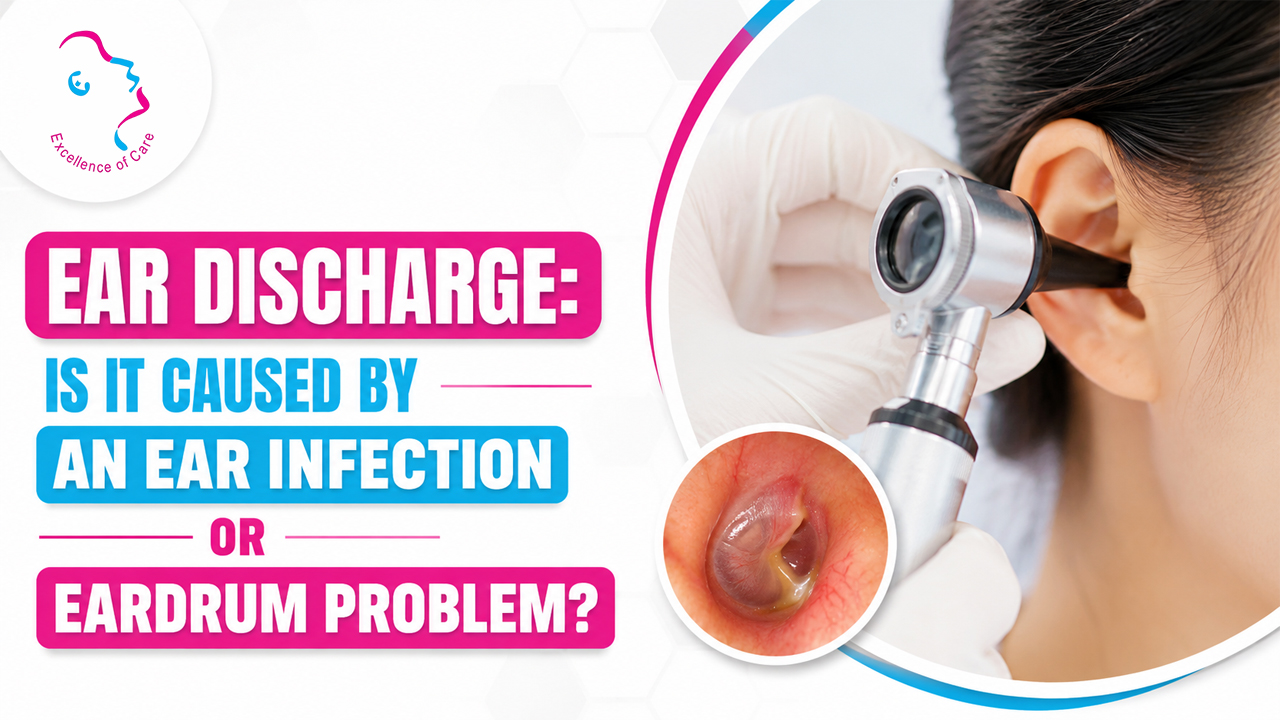
Ear discharge can happen because of an infection, a perforated eardrum, inflammation of the ear canal, chronic middle-ear disease or, less commonly, another medical problem. The appearance of the fluid alone cannot reliably tell you what the cause is.
Pain after swimming may point toward an outer-ear infection, while discharge that begins after severe ear pain may sometimes occur when pressure from a middle-ear infection causes the eardrum to perforate. Repeated drainage with hearing difficulty may require assessment for a persistent eardrum or middle-ear problem.
The safest approach is to consider where the drainage is coming from, how long it has been present and what other symptoms occur with it.
This article explains the major causes, how infection differs from an eardrum problem, warning signs to watch for and when an ENT examination may be appropriate.
Medical note: This information is for general education and does not diagnose an individual ear condition.
What Does Ear Discharge Mean?
Ear discharge is fluid that comes out of the ear canal. The medical term is otorrhea.
The fluid may be:
- watery or clear
- cloudy
- yellow or pus-like
- blood-stained
- thick
- foul-smelling
- intermittent or
- continuously draining.
These features give a clinician useful clues, but they are not enough to diagnose the cause by themselves.
The drainage may originate from the skin of the ear canal, from the middle ear through a perforated eardrum, from an injured area or from another less common source. Otoscopic examination often helps identify uncomplicated causes such as an outer-ear infection, perforation or middle-ear disease.
That is why two people with apparently similar yellow ear discharge may have different conditions and require different treatment.
Ear Infection or Eardrum Problem: What Is the Difference?
Both infection and eardrum disease can cause ear drainage, and sometimes they occur together.
| Pattern | Possible explanation | Other clues |
| Pain after swimming with itching and tenderness when the outer ear is touched | Outer-ear infection | Swollen/red canal, itching, drainage |
| Severe earache followed by drainage | Middle-ear infection with eardrum perforation | Fever, recent respiratory infection, hearing change |
| Drainage after injury, loud blast or pressure change | Eardrum perforation | Sudden pain, tinnitus or reduced hearing |
| Repeated or long-lasting discharge | Chronic middle-ear disease or persistent perforation | Hearing difficulty, previous infections |
| Foul-smelling recurrent drainage | Chronic infection or possible cholesteatoma | Hearing loss, persistent symptoms |
| Clear or bloody drainage after major head trauma | Possible serious injury | Requires urgent assessment |
The pattern helps guide assessment, but a diagnosis should not be made from symptoms alone.
What Are the Most Common Causes of Ear Discharge?
1. Outer-ear infection or swimmer's ear
Otitis externa affects the ear canal rather than the middle ear.
Water remaining in the ear canal can create conditions that allow bacteria to multiply. Trauma from scratching or inserting objects into the ear can also damage the canal's protective skin.
Typical symptoms can include:
- pain
- itching
- redness
- swelling
- ear fullness
- temporary hearing difficulty and
- drainage.
One useful clue is pain when the outer ear is pulled or pressure is placed near the entrance to the ear canal. The CDC identifies pain with ear movement, itching, drainage, redness and swelling as typical features of swimmer's ear.
Anyone with suspected infection and discharge should be examined before assuming that ordinary over-the-counter ear drops are appropriate.
ENT Care Center's ear infection evaluation and treatment service includes assessment of outer-ear, middle-ear, fungal and eardrum-related problems. The clinic states that the ear canal and eardrum are examined to determine the likely source of symptoms.
2. Middle-ear infection with eardrum perforation
A middle-ear infection occurs behind the eardrum.
Fluid and inflammation can increase pressure inside the middle ear. In some cases, the eardrum develops a small opening and infected fluid drains into the ear canal.
A person may notice:
- ear pain;
- fever;
- blocked-ear sensation;
- reduced hearing; or
- pus-like drainage.
Sometimes pain decreases after the eardrum opens because pressure has been released. This does not necessarily mean that the underlying ear problem has resolved.
NICE specifically recognizes otorrhoea following eardrum perforation as a presentation that can occur with acute otitis media in children and young people.
An ENT examination can help establish whether drainage is originating from the ear canal or passing through an opening in the eardrum.
3. Perforated eardrum from injury or pressure
An eardrum perforation means there is a hole or tear in the tympanic membrane.
It can happen after:
- an ear infection
- inserting an object into the ear
- a blow to the ear
- a sudden loud blast or
- a rapid pressure change.
Symptoms may include sudden pain, hearing reduction, tinnitus, dizziness, blood or clear/pus-like fluid from the ear.
Many uncomplicated perforations can heal, but not every case follows the same course. Ongoing drainage, infection or hearing loss needs reassessment.
ENT Care Center provides a specific eardrum perforation evaluation pathway that considers the size of the perforation, infection history, hearing condition and whether medical follow-up or surgical treatment may eventually be appropriate.
4. Chronic middle-ear infection
Ear discharge that keeps returning should not simply be treated as a series of unrelated minor infections.
Chronic suppurative otitis media is characterized by chronic drainage from the middle ear through a perforated eardrum and may be associated with conductive hearing loss.
A person may experience:
- recurrent drainage
- little or no pain between episodes
- unpleasant smell
- hearing difficulty
- discharge after water enters the ear or
- a known eardrum perforation.
Repeated drainage is particularly important because chronic middle-ear disease can affect hearing and may require more than repeated short-term self-treatment.
Depending on the findings, assessment may include examination of the eardrum and a hearing assessment. ENT Care Center states that its hearing pathway may include pure-tone audiometry, tympanometry or other tests according to the patient's symptoms and clinical findings.
5. Cholesteatoma
A cholesteatoma is an abnormal collection of keratinizing tissue within or around the middle ear.
It can be associated with:
- persistent or recurrent ear drainage
- hearing loss
- ear discomfort or
- visible debris within the ear.
Cholesteatoma matters because it can damage nearby structures if it progresses. Diagnosis involves clinical examination and may include hearing testing and imaging when indicated.
Foul-smelling discharge does not automatically mean cholesteatoma, but persistent or recurrent drainage—especially with hearing reduction—should not be ignored.
Some chronic ear conditions may eventually require an ear surgery consultation, although surgery is not necessary for every person with ear discharge.
6. Foreign body or ear-canal irritation
This is particularly relevant in children.
Small objects inside the ear can remain unnoticed and eventually produce irritation, pain, infection or foul-smelling drainage. Merck's clinical review notes that foreign bodies can trigger inflammation and purulent drainage.
Do not attempt blind removal using tweezers, pins, matchsticks, cotton buds or other tools.
Trying to remove an object without seeing its position can push it deeper or injure the ear canal or eardrum.
7. Rare but important causes
Most ear discharge is caused by local ear conditions, but there are uncommon situations that require urgent attention.
One example is clear or blood-stained drainage following significant head trauma, which can indicate a serious skull-base injury or cerebrospinal-fluid leak.
Recent major head injury, neurological symptoms, marked dizziness, fever, hearing loss and redness or swelling around the ear are among the warning findings listed in clinical evaluation guidance for ear discharge.
This type of presentation should not be treated as a routine ear infection.
Does the Colour of Ear Discharge Tell You the Cause?
Not reliably.
Colour and consistency can provide clues, but they should be interpreted together with pain, duration, hearing changes, recent swimming, injury, fever and examination findings.
Yellow or pus-like discharge
This may occur with infection, including drainage from the middle ear through a perforation.
Clear or watery discharge
It may occur with irritation or an eardrum-related problem. Clear drainage after significant head injury is different and needs urgent medical assessment.
Bloody discharge
Blood can follow trauma, scratching or eardrum injury. The context matters.
Foul-smelling discharge
An unpleasant smell can occur with chronic infection or debris. Persistent foul drainage warrants examination rather than repeated home cleaning.
Earwax-like material
Normal earwax is not the same as active ear discharge. However, irritation, impacted wax or a foreign object can occasionally complicate the picture.
Practical rule: Do not try to diagnose the source from colour alone.
Can Ear Discharge Occur Without Pain?
Yes.
Pain is common with some acute infections, especially inflammation of the external ear canal. However, chronic middle-ear disease can produce drainage with limited pain.
This is one reason recurrent painless drainage should not be dismissed.
Persistent drainage plus hearing reduction can suggest disease affecting the eardrum or middle ear and deserves clinical assessment. Chronic suppurative otitis media, for example, can present with relatively painless drainage and conductive hearing loss.
When Is Ear Discharge More Concerning?
Seek prompt medical assessment when ear discharge occurs with:
- sudden or significant hearing loss;
- severe dizziness or vertigo;
- facial weakness or another neurological symptom;
- high fever or severe illness;
- marked swelling or redness around the ear;
- severe or rapidly worsening pain;
- significant head or ear trauma;
- blood or clear drainage following major head injury;
- a suspected foreign body;
- recurrent or persistent discharge;
- diabetes or significant immune suppression with severe ear symptoms.
These findings do not prove that a complication is present, but they change how urgently the problem should be evaluated.
Sudden hearing loss should receive prompt medical assessment rather than being assumed to be wax or ordinary congestion. ENT Care Center also identifies sudden hearing loss, severe ear pain with significant illness and hearing loss after trauma among symptoms requiring urgent evaluation.
How Does an ENT Doctor Find the Cause of Ear Discharge?
The first goal is to identify where the drainage is coming from.
1. Symptom history
The clinician may ask:
- When did the discharge begin?
- Is one ear or both ears affected?
- Is it continuous or intermittent?
- Is there pain or itching?
- Did the problem begin after swimming?
- Was there a cold or recent ear infection?
- Was there an injury, slap, loud sound or flight?
- Has the ear discharged before?
- Has hearing changed?
- Are dizziness, tinnitus or fever present?
- Have any drops, oils or medicines already been used?
These questions help separate external-ear, middle-ear and traumatic causes.
2. Ear examination
An otoscope or another appropriate ear-examination method can be used to inspect:
- the external canal;
- swelling or debris;
- the eardrum;
- a possible perforation;
- middle-ear findings; and
- other structural changes.
Clinical guidance notes that otoscopic examination can identify many uncomplicated causes of otorrhea.
3. Hearing assessment when appropriate
If drainage is recurrent or associated with hearing change, testing may help determine whether hearing has been affected.
ENT Care Center's hearing service includes tests such as:
- pure-tone audiometry;
- tympanometry;
- otoacoustic emissions;
- ABR; or
- other age-appropriate assessments when clinically required.
Not every patient needs every test.
4. Imaging or additional investigation
CT, MRI or other investigations are not routine for every case of ear discharge.
They may be considered when the examination suggests complications, cholesteatoma, significant trauma or another condition that cannot be explained adequately through routine assessment.
What Should You Avoid Doing When Your Ear Is Discharging?
Do not insert cotton buds or other objects
Cotton buds may push material deeper and can damage the ear canal or eardrum.
The CDC specifically advises against inserting objects into the ear canal and notes that earwax has a protective role.
Do not repeatedly clean deep inside the ear
Wiping only material that reaches the outer ear is different from inserting something into the canal.
Deep cleaning can worsen irritation or trauma.
Do not automatically use leftover ear drops
Different causes of ear discharge require different management.
Importantly, treatment selection can change when the eardrum is perforated. Professional guidelines distinguish treatment when the tympanic membrane is not intact, so unprescribed drops should not be chosen blindly.
Do not pour oil or home mixtures into a discharging ear
This can make assessment more difficult and may be inappropriate when an infection, injury or eardrum perforation is present.
Keep water out until the cause is clear
People with drainage or a suspected perforation should obtain individual advice before swimming or using ear-drying preparations. CDC guidance specifically advises against drying drops when there is ear drainage or a punctured eardrum.
Ear discharge that keeps returning, affects hearing or occurs with pain, fever or dizziness deserves proper examination rather than repeated self-treatment.
ENT Care Center provides ENT specialist consultation in Kathmandu for ear discharge, infection, eardrum problems and hearing-related concerns. The clinic's consultation pathway includes symptom review, focused examination and additional testing only when clinically appropriate.
Ear Discharge in Children: What Should Parents Notice?
Children may not clearly explain pain, hearing difficulty or dizziness.
A parent may instead notice:
- fluid or pus from the ear;
- pulling or rubbing the ear;
- irritability;
- poor sleep;
- fever;
- reduced response to sound;
- changes in speech or communication;
- repeated ear infections; or
- an unpleasant smell from one ear.
A foreign body should also be considered when one-sided foul-smelling discharge develops in a child, particularly when no typical infection history is present.
Children with repeated ear infections or discharge may also need hearing assessment because middle-ear problems can temporarily affect hearing.
ENT Care Center's pediatric ENT care service includes evaluation for ear infections, discharge and hearing concerns. The clinic also offers audiology support for children when needed.
Can Ear Discharge Get Better Without Treatment?
Sometimes the underlying condition may improve, but this depends entirely on the cause.
For example, some uncomplicated eardrum perforations can heal spontaneously. NHS guidance states that many perforated eardrums heal without surgery, although infection or persistent symptoms may require further treatment.
Other conditions behave differently.
An outer-ear infection may require appropriate topical treatment. Recurrent middle-ear drainage can indicate persistent disease. Cholesteatoma generally requires specialist management.
Therefore, the question should not only be:
“Will the discharge stop?”
A better question is:
“Why is the ear discharging, and has the condition affected the eardrum or hearing?”
Temporary disappearance of fluid does not always mean the original problem has been resolved.
How Is Ear Discharge Treated?
There is no single treatment for all ear discharge.
Treatment depends on the diagnosis.
| Cause | General management direction | Key limitation |
| Outer-ear infection | Canal assessment, appropriate prescribed topical treatment, water precautions | Treatment changes if the eardrum is not intact |
| Middle-ear infection | Age- and severity-specific management | Not every case requires the same medication |
| Eardrum perforation | Keep ear protected, treat infection when present, follow healing and hearing | Persistent perforation may require further intervention |
| Chronic middle-ear disease | Ear examination, infection control, hearing assessment, specialist follow-up | Repeated short-term self-treatment may miss underlying disease |
| Cholesteatoma | Specialist assessment, audiology/imaging when indicated | Often requires definitive specialist treatment |
| Foreign body | Visualized, controlled removal | Blind home removal may worsen injury |
Treatment should follow the cause rather than the colour of the discharge.
A Practical Checklist Before Your ENT Appointment
Bring or remember the following:
- When the discharge started
- Which ear is affected
- Whether it has happened before
- Colour, smell and approximate amount
- Ear pain or itching
- Hearing changes
- Fever, tinnitus or dizziness
- Recent swimming or water exposure
- Recent cold or respiratory infection
- Any blow, loud sound, flight or pressure change
- Anything inserted into the ear
- Ear drops, antibiotics, oils or home remedies already used
- Previous ear surgery or known eardrum perforation
- Previous hearing-test reports
This information does not diagnose the problem, but it can make the clinical assessment more efficient.
When Should You See an ENT Specialist for Ear Discharge?
Arrange an ENT evaluation when discharge:
- persists;
- keeps coming back;
- has an unpleasant smell;
- occurs with hearing difficulty;
- follows an ear injury;
- starts whenever water enters the ear;
- occurs with recurrent infection;
- is associated with tinnitus or dizziness; or
- has not responded as expected to previous treatment.
More urgent assessment is appropriate when there is sudden hearing loss, significant trauma, severe illness, neurological symptoms or marked swelling around the ear.
ENT Care Center's website identifies ear discharge, repeated ear infection, eardrum injury and reduced hearing among reasons to seek an ENT consultation.
Key Takeaways
Ear discharge is a symptom not a diagnosis.
An outer-ear infection, middle-ear infection, perforated eardrum, chronic middle-ear disease, injury, foreign body or another condition can all produce drainage.
The most useful clues are:
cause or trigger + duration + pain/itching + hearing change + examination findings.
Do not rely only on discharge colour, and avoid inserting objects, oils or unprescribed drops into a draining ear.
Persistent, recurrent or concerning ear discharge should be evaluated so the ear canal, eardrum and hearing can be assessed appropriately.
If you have repeated ear discharge, hearing change, ear pain or a suspected eardrum problem, you can request an ENT consultation at ENT Care Center in Kathmandu for clinical assessment and guidance on the appropriate next step.
FAQs
1. Is ear discharge always caused by an infection?
No. Infection is a common cause, but discharge can also occur because of a perforated eardrum, ear-canal irritation, injury, a foreign body or chronic middle-ear disease. The source is usually determined from the history and examination rather than fluid colour alone.
2. Can a perforated eardrum cause ear discharge?
Yes. A perforated eardrum can allow fluid from the middle ear to drain into the ear canal. Other symptoms may include hearing reduction, tinnitus, pain or dizziness. Infection is one possible cause of the perforation.
3. What does yellow or pus-like ear discharge mean?
Yellow or pus-like fluid may occur with infection, but its appearance cannot identify the exact location or cause. A clinician may need to determine whether the discharge comes from the ear canal or from the middle ear through an eardrum perforation.
4. Why is clear fluid coming from my ear?
Clear drainage has several possible causes. Persistent unexplained drainage should be assessed. Clear or blood-stained fluid following significant head trauma is different and requires urgent medical evaluation because serious injury must be excluded.
5. Can ear discharge happen without pain?
Yes. Some chronic middle-ear conditions can cause recurrent drainage with little pain. Chronic suppurative otitis media, for example, can present with relatively painless discharge and hearing loss.
6. Can an ear infection cause a hole in the eardrum?
Yes. Pressure and inflammation from a middle-ear infection can sometimes lead to perforation of the eardrum, allowing infected fluid to drain outward.
7. Can ear discharge affect hearing?
Yes. Conditions involving canal swelling, middle-ear fluid, infection or eardrum perforation can affect sound transmission and reduce hearing. Persistent or noticeable hearing changes may require audiological assessment.
8. Should I put ear drops into an ear that is discharging?
Do not choose unprescribed drops without knowing the condition of the ear canal and eardrum. Treatment selection matters when an eardrum perforation or ear tube is present.
9. Should I keep a discharging ear dry?
Generally, avoiding water in a draining ear is sensible until its cause is evaluated. The CDC advises against ear-drying drops when a person has ear drainage, ear tubes or a perforated eardrum.
10. When should I see an ENT doctor for ear discharge?
Seek assessment when discharge persists, returns repeatedly, smells unpleasant or occurs with hearing loss, significant pain, fever, dizziness, trauma or swelling. Sudden hearing loss or neurological symptoms require more urgent evaluation.