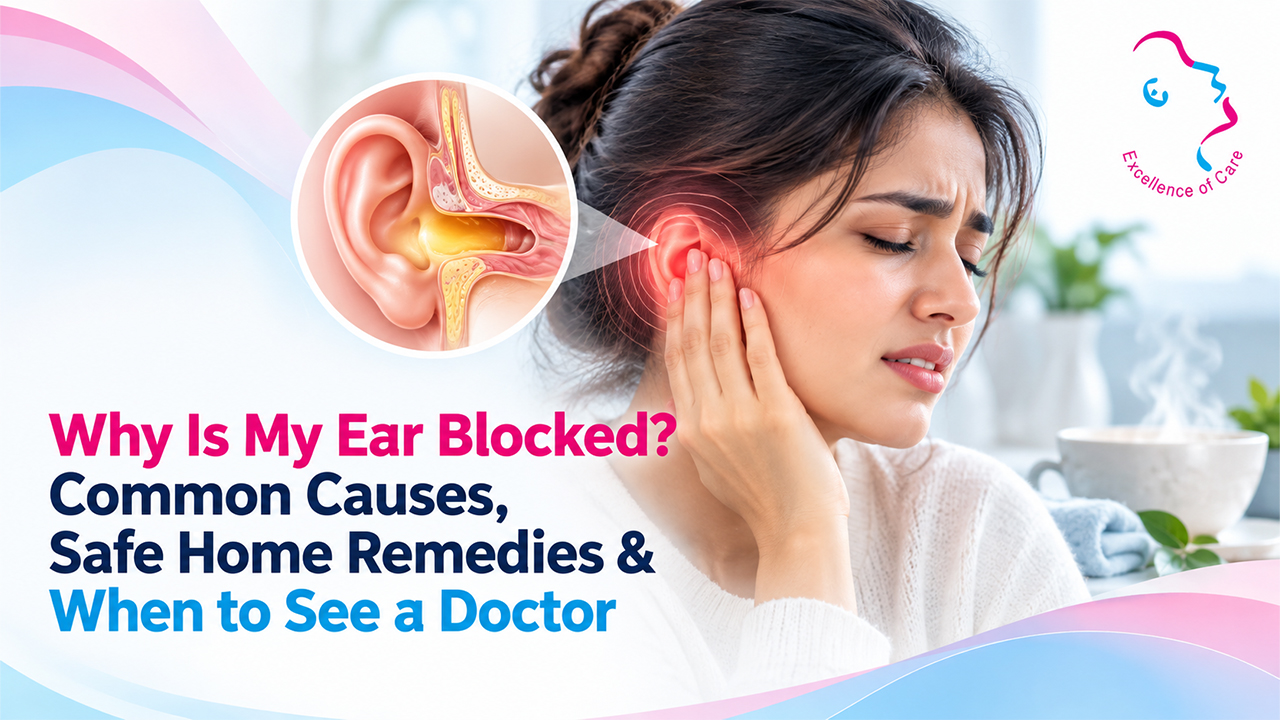
Does your ear feel blocked, full, or as if something is stuck inside? Perhaps sounds seem muffled, your hearing feels reduced, or your ear keeps popping without becoming completely clear.
A blocked ear can result from earwax buildup, a common cold, allergies, Eustachian tube dysfunction, changes in air pressure, or an ear infection. Some cases improve naturally, while others require treatment from an ear, nose, and throat (ENT) specialist.
However, not every blocked-ear sensation is caused by something physically blocking the ear canal.
Important: If your hearing suddenly becomes reduced in one or both ears, seek urgent medical assessment, even if you have no pain. Sudden inner-ear hearing loss can initially feel like an ordinary blocked ear and should not be mistaken for earwax.
This guide explains why ears become blocked, which symptoms may suggest different causes, how to manage mild symptoms safely, and when to visit an ENT clinic in Kathmandu or elsewhere in Nepal.
What Does It Mean When Your Ear Feels Blocked?
A blocked ear is a sensation of fullness, pressure, reduced hearing, or obstruction inside the ear.
People describe the experience in different ways:
"My ear feels full."
"I can hear, but everything sounds muffled."
"It feels like water is trapped in my ear."
"My ear keeps popping."
"One ear feels blocked, but there is no pain."
The sensation may affect one ear or both.
To understand possible causes, it helps to know that the ear has three main parts.
Outer ear: Includes the ear canal, where earwax normally forms. Excessive wax can physically obstruct sound.
Middle ear: Contains the eardrum and small hearing bones. It connects to the back of the nose through the Eustachian tube, which helps equalize pressure.
Inner ear: Contains structures involved in hearing and balance. Some inner-ear disorders cause hearing changes or fullness even when there is no visible obstruction.
This distinction matters because treatment depends on which part of the ear is affected.
For example, earwax-softening drops may help selected cases of wax buildup but will not correct an inner-ear hearing disorder or necessarily relieve pressure behind the eardrum.
Why Is My Ear Blocked? Seven Possible Causes
1. Earwax Buildup (Cerumen Impaction)
Excessive earwax is a common cause of a blocked-ear sensation.
Earwax, medically called cerumen, is a normal substance that helps protect the ear canal from dirt and irritation.
Usually, earwax gradually moves toward the opening of the ear and falls out naturally.
However, wax may accumulate or become impacted, particularly when a person uses cotton buds or other objects inside the ear canal.
Common symptoms of earwax blockage include:
A plugged or full feeling
Muffled hearing
Itching inside the ear
Ringing or buzzing sounds
Mild discomfort
Occasionally dizziness
Some people experience noticeable hearing difficulty without pain.
According to the American Academy of Otolaryngology's patient guidance on earwax blockage, cotton-tipped swabs frequently push wax deeper and can injure the ear canal or eardrum.
Earwax buildup should not be diagnosed based on symptoms alone. An ear examination is needed to confirm that wax is responsible.
If a clinician confirms impacted wax, professional earwax removal in Kathmandu may be appropriate.
2. Eustachian Tube Dysfunction
The Eustachian tube connects the middle ear to the back of the nose and upper throat.
It helps regulate air pressure on both sides of the eardrum and allows fluid to drain from the middle ear.
When the tube does not open and close normally, pressure may become trapped behind the eardrum.
This is called Eustachian tube dysfunction (ETD).
Common symptoms include ear fullness, popping, clicking, muffled hearing, and pressure that may change when swallowing or yawning.
ETD often develops during or after:
A common cold
Nasal congestion
Allergic rhinitis
Sinus or upper respiratory inflammation
Air-pressure changes during flights
According to the Mayo Clinic's explanation of plugged ears after a cold, congestion-related Eustachian tube blockage often improves as swelling subsides.
Persistent symptoms require examination, especially when hearing is affected.
3. Ear Infection
An ear infection can cause pain, blocked-ear sensation, reduced hearing, or discharge.
There are different types of ear infections.
Outer ear infection (otitis externa): Involves inflammation or infection of the ear canal. Symptoms may include itching, pain when the outer ear is touched or moved, swelling, discharge, and muffled hearing.
Middle ear infection (otitis media): Involves the space behind the eardrum. It may cause earache, pressure, fever, and hearing changes.
Some infections cause considerable pain. Others initially produce fullness or reduced hearing.
Do not assume that every blocked ear is caused by an infection or that antibiotics are always necessary.
Treatment depends on the actual diagnosis.
Learn more about ear infection evaluation and treatment at ENT Care Center.
4. Cold, Flu, or Nasal Allergies
Your nose and ears are connected through the Eustachian tubes.
During a cold or allergic episode, inflammation in the nose and throat may interfere with normal middle-ear pressure regulation.
A blocked-ear sensation may therefore occur alongside:
A stuffy or runny nose
Sneezing
Coughing
Nasal irritation
Facial pressure
Reduced or muffled hearing
The sensation may improve as the underlying congestion settles.
However, nasal sprays, allergy medicines, and decongestants are not suitable for everyone, and not all have the same evidence of benefit for ear symptoms.
Seek medical or pharmacist advice before using medication, particularly if you have other health conditions, take regular medicines, or are pregnant.
5. Air-Pressure Changes During Flying or Mountain Travel
Changes in altitude can cause temporary ear blockage.
For example, some people experience pressure, discomfort, or muffled hearing while flying or travelling to higher elevations.
This happens when pressure on either side of the eardrum cannot equalize quickly enough.
The condition is sometimes called ear barotrauma.
The American Academy of Otolaryngology's guidance on ears and altitude explains that swallowing, yawning, or chewing gum can help the Eustachian tubes open during pressure changes.
However, severe pain, significant dizziness, bleeding, or persistent hearing loss after pressure exposure warrants medical assessment.
6. Water Trapped in the Ear After Swimming or Bathing
Sometimes, ears feel blocked immediately after swimming, showering, or washing the hair.
A small amount of water may remain in the outer ear canal, producing a temporary clogged sensation.
You can gently tilt your head to the affected side and allow the water to drain. Moving the outer ear gently may help.
Do not insert cotton buds, fingers, pins, or other objects to remove the water.
If blockage persists, or you develop itching, increasing pain, discharge, or hearing difficulty, arrange an ear examination. Persistent moisture can contribute to outer-ear irritation or infection.
7. Middle-Ear Fluid or Inner-Ear Hearing Problems
Not every blocked ear involves earwax or congestion.
Fluid may accumulate behind the eardrum, sometimes after a respiratory infection or because of Eustachian tube dysfunction.
Middle-ear fluid can cause muffled hearing and fullness without severe pain.
Other conditions affecting the inner ear may produce hearing loss, tinnitus, dizziness, or a blocked sensation.
One important example is sudden sensorineural hearing loss, which can occur without an obvious external-ear problem.
The National Institute on Deafness and Other Communication Disorders (NIDCD) warns that sudden hearing loss is a medical emergency and may be mistaken for earwax or congestion.
If hearing suddenly changes, seek urgent medical attention rather than waiting to see whether wax-softening drops help.
Blocked Ear Symptoms: What Could They Indicate?
Different symptom combinations may suggest different causes.
| Symptoms | Possible explanation | Recommended next step |
|---|---|---|
| Gradual fullness, itching and muffled hearing | Earwax buildup | Arrange assessment if persistent or affecting hearing |
| Popping and pressure after a cold | Eustachian tube dysfunction | Gentle pressure-equalising actions may help; seek care if persistent |
| Ear pain, fever or discharge | Ear infection or another inflammatory condition | Prompt medical assessment |
| Blockage after flying | Pressure-related ear problem | Seek evaluation if significant or persistent |
| Fullness after swimming | Trapped water or ear-canal irritation | Avoid inserting objects; arrange assessment if symptoms persist |
| New sudden hearing reduction, even without pain | Possible sudden hearing loss | Urgent medical assessment |
| Fullness with severe vertigo or neurological symptoms | Possible inner-ear or neurological problem | Emergency assessment |
This table is an educational guide, not a diagnostic test.
Two people with similar blocked-ear symptoms may have entirely different underlying conditions.
Why Is My Ear Blocked for Two Weeks Without Pain?
A blocked ear that lasts two weeks without pain should not automatically be considered harmless.
Possible explanations include impacted earwax, lingering Eustachian tube dysfunction after a cold, middle-ear fluid, or a hearing disorder.
If your ear has remained blocked for two weeks, arrange a medical examination rather than continuing repeated home remedies.
An ENT specialist can examine the ear canal and eardrum to identify whether a physical blockage is present.
If no obvious obstruction is found, a hearing test or middle-ear assessment may be necessary.
It is especially important to seek evaluation if:
Only one ear is affected
Hearing is noticeably reduced
The blockage is getting worse
You have persistent tinnitus
You experience dizziness
The problem keeps returning
A painless ear problem can still affect hearing.
If hearing loss started suddenly at any point, seek urgent medical care rather than waiting for a routine appointment, even if symptoms have already lasted several days.
Can a Blocked Ear Clear on Its Own?
Yes, some causes improve naturally.
Mild congestion-related pressure may resolve after a cold, while small amounts of earwax often move out of the ear without treatment.
However, there is no reliable way to predict recovery from the sensation alone.
Persistent or worsening symptoms deserve clinical assessment.
Mayo Clinic advises seeking medical care when cold-related plugged-ear symptoms are severe or last more than two weeks.
How to Open a Blocked Ear at Home Safely
The safest home approach depends on the likely cause of the blockage.
There is no single home remedy that treats every blocked ear.
Before trying home treatment, consider whether your hearing changed suddenly, whether you have pain or discharge, and whether you have a history of eardrum perforation or ear surgery.
If Your Ear Feels Blocked After a Cold
When mild pressure is associated with nasal congestion, swallowing, yawning, and chewing gum may help the Eustachian tube open.
Some people find gentle pressure-equalising manoeuvres helpful.
However, do not forcefully blow against a pinched nose or repeatedly attempt to pop an ear that is painful, injured, or severely blocked.
Avoid this type of self-treatment following ear trauma or recent ear surgery unless your clinician approves it.
A saline nasal spray may help relieve nasal congestion, although it does not directly remove earwax or guarantee that the ear will open.
If Your Ear Feels Blocked From Earwax
For adults with mild, gradual symptoms that appear consistent with uncomplicated earwax, a pharmacist may recommend an appropriate wax-softening product.
The NHS describes using suitable oil-based or other earwax-softening drops for selected cases.
Products must be used according to their instructions and the patient's circumstances.
Do not put oil or earwax-removal drops in your ear if you have:
A known or suspected perforated eardrum
Ear tubes or a relevant history of ear surgery without medical approval
Ear discharge or bleeding
Significant ear pain
A suspected infection
A foreign object in the ear
Sudden or unexplained hearing loss that has not been assessed
People with diabetes, reduced immunity, or complex ear disease should seek professional advice before attempting home wax removal or irrigation.
If you are uncertain whether wax is causing the blockage, have your ear examined first.
For additional patient guidance, see the NHS recommendations for earwax buildup.
If Water Is Trapped After Bathing
Gently tilt your head to the affected side and allow the water to drain.
Avoid using sharp objects, cotton buds, or other tools inside the canal.
If your ear remains blocked, becomes painful, or develops discharge, arrange an examination.
What Should You Never Do to a Blocked Ear?
Several popular methods can cause more harm than benefit.
Do not insert cotton buds or metal objects. They can push wax deeper and injure the eardrum.
Do not use ear candles. There is no reliable evidence that they remove earwax, and they can cause burns or injury.
Do not use high-pressure water devices. Forceful irrigation may damage delicate ear structures.
Do not repeatedly use unprescribed ear drops. Drops intended for one condition can be inappropriate when the actual problem is infection or eardrum damage.
Do not delay assessment of sudden hearing changes. The feeling that something is blocking the ear does not rule out an inner-ear problem.
How to Remove Earwax Blockage Safely
If earwax is confirmed as the cause, removal can be straightforward, but the appropriate method depends on the condition of the ear canal and eardrum.
1. Earwax-Softening Drops
A clinician or pharmacist may recommend a product that softens impacted wax.
The wax may then move out naturally or become easier to remove professionally.
Drops are not appropriate for everyone and may cause irritation.
2. Microsuction
Microsuction is a professional technique in which a trained clinician uses controlled suction to remove earwax while viewing the ear canal.
It avoids flushing water into the ear, which may be advantageous in certain circumstances.
However, microsuction can occasionally cause discomfort, temporary dizziness, or other unwanted effects.
It is not suitable for every patient.
3. Professional Irrigation
Irrigation uses an appropriate flow of liquid to help remove earwax.
Before recommending irrigation, a clinician should assess the ear canal, eardrum and relevant medical history.
Irrigation may be unsuitable in people with previous eardrum perforation, some ear surgeries, active ear conditions, or other risk factors.
4. Manual Wax Removal
A trained healthcare professional may remove wax using specialized instruments, often with magnification.
This may be preferred when wax is difficult to access or irrigation is inappropriate.
According to ENT Health's clinical education on cerumen impaction, professional removal may involve suction, irrigation or specialized instruments, with the choice guided by the patient's ear condition.
What Is the Fastest Way to Remove Earwax Blockage?
If you need rapid relief from suspected impacted wax, the safest practical option is to have the ear examined and, if appropriate, professionally treated.
Home drops often work gradually rather than immediately.
Trying to extract wax quickly with cotton buds, sharp tools, improvised suction or strong water pressure may worsen the problem.
At ENT Care Center's earwax removal service in Kathmandu, the published care pathway begins with an ear examination, followed by an appropriate treatment recommendation.
The specific removal technique and its availability should be confirmed directly with the clinic.
When Is a Blocked Ear an Emergency?
Most blocked-ear complaints are not emergencies. However, certain symptoms require prompt medical attention.
Seek Emergency Medical Care for Sudden Hearing Loss
A sudden drop in hearing can happen over hours or within a few days.
You might notice that:
One ear suddenly sounds much quieter
You wake up unable to hear normally
Hearing changes sharply without pain
New ringing accompanies sudden hearing reduction
Your hearing suddenly changes along with dizziness
This may indicate sudden sensorineural hearing loss.
The NICE hearing-loss guideline recommends immediate referral for recent sudden hearing loss that is not explained by an outer- or middle-ear problem, with specialist assessment within 24 hours.
Do not wait for a routine wax-removal appointment if your hearing has suddenly deteriorated.
Learn more in ENT Care Center's guide to sudden hearing loss and urgent warning signs.
Other Warning Signs
Seek urgent assessment if a blocked ear is accompanied by:
Severe or increasing ear pain
Fever with ear swelling or discharge
Bleeding or significant fluid discharge
Severe spinning dizziness or inability to walk steadily
Hearing difficulty following trauma
New facial weakness
Seek emergency care immediately if hearing changes occur with stroke-like symptoms, such as facial drooping, weakness of an arm or leg, or difficulty speaking.
A suspected button battery or other hazardous object in the ear is also an emergency. Do not attempt to remove it yourself.
How Does an ENT Doctor Diagnose a Blocked Ear?
An ENT specialist first aims to determine whether the problem is in the outer ear, middle ear or hearing system.
1. Medical History
The doctor may ask:
When did the blockage begin?
Did it develop suddenly or gradually?
Is one ear affected or both?
Is there pain, discharge, tinnitus or dizziness?
Have you recently had a cold, allergy symptoms or a flight?
Have you used cotton buds or ear drops?
Have you had ear surgery or previous hearing problems?
The timing of any hearing change is particularly important.
2. Ear Examination
An otoscope or other appropriate examination tool is used to inspect the ear canal and eardrum.
The clinician may identify impacted wax, inflammation, discharge, an eardrum problem or other abnormalities.
If the ear canal looks clear but hearing remains reduced, further assessment may be appropriate.
3. Hearing Assessment
A hearing test helps determine whether hearing loss is present and how it is affecting one or both ears.
Pure-tone audiometry can help distinguish different patterns of hearing loss.
Depending on the clinical findings, tympanometry may be used to assess middle-ear function and eardrum movement.
ENT Care Center provides advanced hearing assessment in Kathmandu, including tests selected according to symptoms and clinical needs.
Not everyone with a blocked ear requires every hearing test.
4. Further Examination When Necessary
If symptoms persist or the initial findings are unusual, the doctor may recommend additional evaluation.
For example, persistent one-sided middle-ear fluid in an adult deserves assessment for possible nasal or Eustachian tube-related causes.
The need for additional testing depends on medical history and examination findings.
What Is the Best Treatment for a Blocked Ear?
The most effective treatment is the one directed at the confirmed cause.
| Cause | Possible clinical approach |
|---|---|
| Earwax impaction | Softening drops or professional removal |
| Eustachian tube dysfunction | Observation, pressure-equalising advice and management of contributing nasal conditions |
| Outer ear infection | Appropriate ear care and condition-specific medicines |
| Middle-ear infection | Examination, symptom management and medicines when indicated |
| Middle-ear fluid | Monitoring, hearing assessment or specialist treatment when needed |
| Pressure injury | Clinical assessment and treatment based on severity |
| Sudden sensorineural hearing loss | Urgent specialist assessment and time-sensitive treatment when indicated |
Antibiotics are not required for all ear infections, and earwax removal is not the correct treatment for every hearing problem.
Likewise, steroid medicines, decongestants and other treatments should not be started solely because an ear feels blocked.
The clinician's task is to identify the cause and recommend treatment appropriate to that condition.
How Can You Prevent Repeated Ear Blockage?
Not every blocked-ear episode is preventable, but several habits may reduce avoidable problems.
Avoid inserting cotton buds into the ear canal. Clean only the visible outer ear gently with a soft cloth.
Do not remove normal earwax unnecessarily. Wax has a protective function, and many ears clean themselves naturally.
Manage recurring nasal and allergy problems appropriately. People with repeated congestion-related ear pressure may benefit from evaluation of the underlying nasal condition.
Take care during flying or altitude changes. Swallowing, yawning and chewing gum during pressure changes may help some travellers.
Keep the ears appropriately dry after swimming. Persistent pain or discharge after water exposure should be medically assessed.
Seek assessment for recurrent blockage. If the same ear repeatedly feels blocked, an examination can help identify why the problem returns.
People who wear hearing aids, use earplugs frequently or have narrow ear canals may need individualized advice about recurring wax buildup.
Ear Blocked? ENT Evaluation in Kathmandu, Nepal
A blocked ear can be uncomfortable, and uncertainty about the cause may be frustrating.
When symptoms are persistent, recurring or associated with hearing changes, an ENT examination can help identify whether the problem involves wax, the ear canal, the eardrum, middle-ear pressure or hearing function.
ENT Care Center is located on Madan Bhandari Road, Kathmandu, Nepal.
The clinic lists ear-related services that include:
ENT specialist consultation
Earwax removal
Ear infection evaluation and treatment
Hearing assessment
Evaluation of eardrum and other ear-related conditions
Patients can explore ENT specialist consultation in Kathmandu for more information about the evaluation process.
For non-emergency concerns, you can request an appointment at ENT Care Center.
Clinic address: Madan Bhandari Road, Kathmandu 44600, Nepal
Appointment contact: 01-4790229
Website: https://entcarecenter.com.np/
Confirm clinic availability before visiting.
If you experience sudden hearing loss or another emergency warning sign, seek immediate appropriate medical care rather than waiting for a routine booking.
Frequently Asked Questions About Blocked Ears
1. Why is only one ear blocked?
One-sided ear blockage may result from wax buildup, Eustachian tube dysfunction, infection, middle-ear fluid or a hearing problem. Persistent or unexplained one-sided symptoms should be examined, particularly if hearing is affected.
2. Why is my ear blocked but not painful?
Earwax buildup, pressure imbalance and middle-ear fluid can sometimes cause fullness without pain. However, sudden hearing loss may also be painless. The absence of pain does not exclude a significant problem.
3. How do I know if earwax is blocking my ear?
Impacted wax may cause gradual muffled hearing, fullness, itching or tinnitus. These symptoms overlap with other ear disorders. An ear examination is needed to confirm a wax blockage.
4. Can a blocked ear last for two weeks?
Yes. Some ear-pressure conditions or wax-related symptoms may persist for two weeks or longer. If the blockage has not improved, arrange medical assessment. Sudden hearing loss requires urgent assessment, regardless of how long it has been present.
5. Can I remove earwax at home?
Some uncomplicated wax buildup can be managed with suitable wax-softening products following pharmacist or clinician advice. Do not insert objects into the ear or use drops when the eardrum may be damaged, infection is suspected, or hearing loss has started suddenly.
6. Why does my ear feel blocked after sleeping?
You may notice fullness more clearly on waking because of wax, nasal congestion, or pressure changes. However, if you wake up with a sudden reduction in hearing, seek urgent medical attention rather than assuming your ear became blocked during sleep.
7. Can sinus problems make my ears feel blocked?
Yes. Nasal inflammation associated with a cold, sinus problem or allergy can affect the Eustachian tubes and cause ear pressure or muffled hearing.
8. Will ear blockage go away without treatment?
Some mild cases resolve naturally, especially temporary pressure imbalance or small amounts of wax. Others require medication, wax removal or investigation. Do not wait if hearing changes suddenly, symptoms worsen, or warning signs develop.
Final Takeaway: Do Not Ignore Persistent Ear Blockage
A blocked ear is a symptom, not a diagnosis.
Earwax buildup, colds, allergies, pressure changes and ear infections are common explanations. However, middle-ear and inner-ear problems can produce similar sensations.
Mild pressure-related symptoms may improve with simple measures, while selected cases of wax buildup may respond to appropriate softening products.
But home remedies are not suitable for every situation.
If your ear has remained blocked for two weeks, keeps becoming blocked, or is affecting your hearing, arrange a medical assessment.
If hearing suddenly decreases, seek urgent care even when there is no pain.
For a persistent or recurring blocked-ear sensation in Kathmandu, contact ENT Care Center for an ENT consultation to discuss examination and appropriate treatment options.
This article provides general health education and does not replace an individualized medical examination, hearing assessment or professional treatment advice.