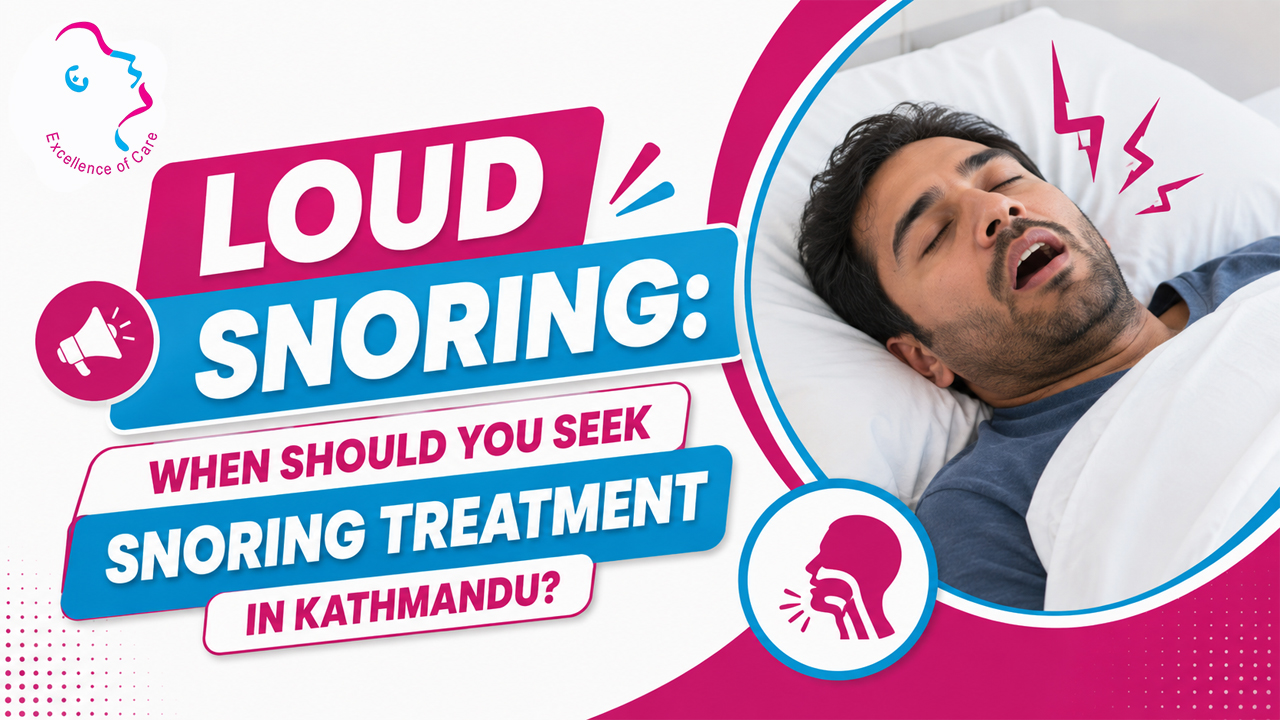
Loud snoring is more than a harmless sleep habit when it is frequent, worsening or accompanied by choking, gasping, witnessed breathing pauses, restless sleep, morning headaches or excessive daytime sleepiness. These signs may indicate sleep-disordered breathing, including obstructive sleep apnea, and should be assessed by a qualified healthcare professional.
Not everyone who snores has sleep apnea. However, the sound alone cannot reliably show whether the condition is mild or serious. A person with quieter snoring may still have important breathing interruptions, while another person may snore loudly without repeated airway closure. The pattern of breathing, sleep quality and daytime symptoms matter more than volume alone.
For people seeking snoring treatment in Kathmandu, evaluation should begin by identifying why the airway is narrowing during sleep. Possible contributors include nasal congestion, allergy, a deviated septum, enlarged tonsils, throat anatomy, body-weight-related airway narrowing and sleeping position.
What exactly causes snoring?
Snoring is the sound produced when air moves through a narrowed upper airway and causes relaxed tissues in the nose or throat to vibrate. The sound may come from the soft palate, uvula, throat walls, tongue area or a combination of structures.
During sleep, muscles naturally relax. In some people, this makes the airway narrower. Air then moves through the restricted space with greater turbulence, producing vibration and sound.
A temporary episode of snoring may happen during a cold, nasal congestion or extreme tiredness. Persistent snoring suggests that one or more airway, sleep or health factors may be repeatedly affecting airflow.
Snoring is therefore a sound, not a complete diagnosis. Two people who sound similar at night may have very different underlying problems and may require different treatment.
When is loud snoring more than a sleep habit?
Loud snoring becomes more concerning when it forms part of a wider breathing and sleep pattern.
The following four-part framework can help families describe the problem accurately:
Sound: How loud and disruptive is the snoring?
Breathing: Are there pauses, gasps, choking sounds or struggling breaths?
Sleep: Is sleep restless, repeatedly interrupted or unrefreshing?
Daytime impact: Is there sleepiness, fatigue, poor concentration or morning headache?
| Pattern | What it may suggest | Recommended action |
|---|---|---|
| Occasional snoring during a cold | Temporary nasal congestion | Monitor as the illness improves |
| Snoring mainly while lying on the back | Position-related airway narrowing | Discuss positional and other factors if persistent |
| Frequent snoring with blocked nose | Possible nasal or sinus obstruction | Consider an ENT assessment |
| Loud snoring with gasping or choking | Possible sleep-disordered breathing | Arrange medical evaluation |
| Snoring with witnessed breathing pauses | Possible obstructive sleep apnea | Discuss a sleep-apnea assessment |
| Snoring with severe daytime sleepiness | Poor-quality or interrupted sleep | Seek timely evaluation |
| Snoring with high blood pressure or relevant medical conditions | Possible additional health significance | Discuss with a healthcare professional |
| A child who snores regularly | Possible tonsil, adenoid or airway problem | Arrange paediatric or ENT assessment |
The table is a decision aid, not a diagnostic tool. Sleep apnea cannot be confirmed by listening to snoring alone.
What are the common causes of loud snoring in adults?
Snoring often develops through several factors acting together. For example, a person may have nasal allergy, sleep on their back and also have throat narrowing. Treating only one factor may therefore produce limited improvement.
Nasal congestion and allergy
A blocked nose can increase resistance to airflow and encourage mouth breathing during sleep. Common causes include allergic rhinitis, infection, sinus inflammation, swollen nasal tissue and environmental irritation.
People may notice:
- A blocked nose at night
- Sneezing or a runny nose
- Mouth breathing
- Dry mouth after waking
- Reduced sense of smell
- Snoring that worsens during allergy seasons
- Snoring during a cold or sinus episode
Persistent blockage deserves proper examination rather than repeated unsupervised use of nasal products. ENT Care Center provides evaluation for persistent nasal blockage, including assessment for allergy, sinus problems, polyps and structural obstruction.
Deviated nasal septum
The nasal septum separates the two sides of the nose. When it is bent or displaced, one side may be narrower, making nasal breathing more difficult.
A deviated septum can contribute to mouth breathing, nighttime congestion and snoring. However, it may not be the only cause. Correcting nasal airflow does not automatically resolve sleep apnea when the airway also collapses farther down in the throat.
Patients with one-sided blockage, repeated mouth breathing or persistent congestion may benefit from deviated nasal septum evaluation.
Enlarged turbinates or nasal polyps
Turbinates are structures inside the nose that help warm and filter air. Allergy or inflammation may cause them to become enlarged. Nasal polyps are soft growths associated with chronic inflammation in some patients.
Either condition may reduce nasal airflow and contribute to snoring, particularly when the person already has another area of airway narrowing.
An ENT specialist may recommend a closer examination when congestion is persistent, one-sided, associated with reduced smell or not responding to appropriate initial care.
Enlarged tonsils or adenoids
Large tonsils can narrow the throat airway. Enlarged adenoids, located behind the nose, are especially relevant in children but may also require assessment in selected older patients.
Possible signs include:
- Mouth breathing
- Regular snoring
- Restless sleep
- Repeated sore throat
- A blocked-nose sound
- Breathing discomfort during sleep
- Witnessed pauses or gasping
The clinical importance depends on age, tonsil size, infection history, breathing pattern and sleep symptoms. Treatment may range from observation and medical management to surgery for selected patients. ENT Care Center has a dedicated page for tonsil and adenoid assessment.
Soft-palate, tongue and throat anatomy
The soft palate, uvula, tongue base and throat walls can contribute to vibration or airway collapse. Some people naturally have a narrower upper airway or tissue that relaxes significantly during sleep.
Anatomy varies from person to person. This is why a treatment that helps one snorer may not work for another.
Body weight and neck-area tissue
Additional tissue around the upper airway can increase the likelihood of airway narrowing during sleep. Obesity is an established risk factor for obstructive sleep apnea, although people at any body weight may develop the condition. Large tonsils, craniofacial anatomy, nasal obstruction and other factors may also be involved.
Weight should be discussed respectfully as one possible clinical factor rather than treated as the only explanation.
Sleeping position
Snoring and obstructive events may worsen when a person sleeps on their back. In this position, the tongue and soft tissues may move backward and reduce airway space.
Position is not the only factor, and side sleeping is not a complete treatment for everyone. However, observing whether the problem changes by position provides useful information during an assessment.
Alcohol, sedatives and muscle relaxation
Alcohol and some sedating medicines can relax airway muscles and worsen snoring or obstructive sleep apnea in susceptible people. Anyone using a prescribed medicine should not stop or change it independently; concerns should be discussed with the prescriber.
Sleep deprivation and extreme tiredness
Insufficient sleep may increase muscle relaxation and worsen snoring in some people. It can also intensify daytime tiredness, making it difficult to know whether fatigue comes from inadequate sleep time, disturbed breathing or both.
Maintaining adequate sleep is helpful, but it does not rule out sleep apnea when breathing pauses or other warning signs are present.
Smoking and airway irritation
Smoke exposure can irritate airway tissues and contribute to inflammation and congestion. Reducing airway irritants is beneficial, but persistent loud snoring still requires cause-specific assessment.
When is loud snoring a possible sign of obstructive sleep apnea?
Obstructive sleep apnea occurs when the upper airway repeatedly becomes partially or completely blocked during sleep. Airflow falls or stops even though the body continues trying to breathe. The brain then briefly activates the person enough to reopen the airway.
These repeated interruptions may be so brief that the person does not remember waking. Nevertheless, sleep can become fragmented, and oxygen levels may fall during some events.
Warning signs include:
- Loud, frequent snoring
- Breathing pauses observed by a partner
- Gasping, snorting or choking during sleep
- Waking suddenly with breathing discomfort
- Restless or repeatedly interrupted sleep
- Dry mouth after waking
- Morning headaches
- Excessive daytime sleepiness
- Irritability or mood changes
- Difficulty concentrating
- Fatigue despite spending enough time in bed
- Falling asleep unintentionally during quiet activities
- High blood pressure alongside sleep symptoms
Loud snoring alone does not confirm sleep apnea, and some people with sleep apnea may not snore noticeably. Assessment must consider the complete symptom pattern.
Why do breathing pauses happen?
During obstructive sleep apnea, the relaxed upper airway becomes too narrow or closes. Air cannot move normally through the nose and throat. The body responds by briefly waking enough to restore muscle tone and reopen the airway.
The cycle may include:
Snoring → reduced airflow → breathing pause → gasping or snorting → brief arousal → breathing resumes
The person may fall asleep again immediately and have no memory of the event.
A different condition, central sleep apnea, occurs when the brain temporarily does not send the signals needed for breathing. This is not usually caused by the same upper-airway obstruction and requires different medical assessment.
How can loud snoring affect sleep and daily life?
Snoring may disturb the snorer, a bed partner or the whole household. However, the main medical concern is whether the sound reflects repeated airway obstruction and poor-quality sleep.
Possible daytime effects include:
- Low energy
- Difficulty waking
- Poor concentration
- Irritability
- Reduced memory
- Morning headache
- Slower reaction time
- Reduced school or work performance
- Unplanned daytime sleep
- Relationship stress related to disrupted sleep
Quality sleep is not only about the number of hours spent in bed. Repeated awakenings or breathing interruptions can make sleep unrefreshing.
Readers wanting broader context can review how ENT conditions may affect sleep, hearing and daily life.
Can snoring or sleep apnea affect overall health?
Simple snoring and obstructive sleep apnea should not be treated as identical conditions. Evidence linking sleep-related breathing disorders with hypertension, cardiovascular disease, stroke, metabolic problems and accident risk primarily concerns diagnosed sleep apnea not every person who occasionally snores.
Repeated airway obstruction can activate stress responses, fragment sleep and cause intermittent reductions in oxygen. Untreated sleep apnea has been associated with important cardiovascular, metabolic and daytime-safety consequences.
This does not mean that every tired person or loud snorer has heart disease. It means that persistent snoring with breathing pauses or daytime symptoms deserves appropriate assessment.
Is loud snoring different in men and women?
Snoring and sleep apnea can affect both men and women. Men are often recognised more readily because classic symptoms such as loud snoring and daytime sleepiness may be more obvious.
Women may also experience snoring, but some present with less typical complaints such as:
- Fatigue
- Insomnia or frequent waking
- Morning headache
- Mood changes
- Poor concentration
- Unrefreshing sleep
Some women with sleep apnea may not report prominent snoring or severe daytime sleepiness, which can contribute to delayed recognition. Symptoms can also change after menopause or during pregnancy.
Neither sex nor body type can rule sleep apnea in or out.
How is chronic snoring diagnosed?
Diagnosis begins with a detailed conversation rather than an immediate procedure.
A clinician may ask:
- How often the snoring occurs
- Whether it happens in every sleeping position
- Whether a partner has noticed breathing pauses
- Whether there is gasping, choking or restless sleep
- Whether the person wakes with dry mouth or headache
- Whether daytime sleepiness affects routine activities
- Whether the nose remains blocked
- Whether allergies or sinus problems are present
- Whether weight has changed
- Which medicines are used
- Whether there are heart, lung, thyroid or neurological conditions
- Whether similar sleep problems occur in the family
A sleep partner’s observations can be valuable because the person who snores may not know what happens after falling asleep.
Physical and ENT examination
The clinician may examine:
- Nasal passages
- Nasal septum
- Turbinates
- Mouth and palate
- Tonsils
- Tongue position
- Throat airway
- Jaw and facial structure
- Neck features relevant to airway assessment
ENT evaluation helps identify visible or structural contributors, but it cannot by itself measure the number of breathing events during sleep.
ENT Care Center provides ENT specialist consultation in Kathmandu for snoring, sleep, nasal, throat and airway concerns.
Is ENT endoscopy always needed?
No. ENT endoscopy is not necessary for every person who snores.
It may be considered when the specialist needs to examine areas that are difficult to see during a routine evaluation, particularly when symptoms suggest:
- Persistent nasal blockage
- Nasal polyps
- Structural obstruction
- Enlarged adenoids
- Sinus drainage problems
- Unexplained one-sided symptoms
- A suspected upper-airway narrowing
The examination can help identify anatomical factors, but it does not replace a sleep study when sleep apnea needs to be diagnosed or measured.
ENT Care Center provides ENT endoscopy in Kathmandu when clinically appropriate.
Should patients record their snoring?
A short audio or video recorded by a partner may help describe the pattern, especially when it captures pauses, choking or position changes. It cannot diagnose sleep apnea, and recordings should never delay medical care when symptoms are concerning.
A simple sleep diary can also record:
- Bedtime and wake time
- Night awakenings
- Sleep position
- Morning symptoms
- Daytime sleepiness
- Alcohol or sedative exposure
- Nasal congestion
- Partner-observed breathing events
The NHLBI notes that sleep diaries can help clinicians understand sleep duration, quality and daytime sleepiness.
Do I need a sleep study for loud snoring?
Not every person who snores needs a sleep study. It is more likely to be recommended when symptoms or clinical findings raise concern for obstructive sleep apnea or another sleep disorder.
A sleep study may be considered when there are:
- Witnessed breathing pauses
- Choking or gasping
- Significant daytime sleepiness
- Morning headache with poor sleep
- Relevant cardiovascular risk
- Persistent symptoms despite initial care
- Uncertainty about the cause
A need to measure severity before selecting treatment
What does polysomnography measure?
An overnight laboratory sleep study, called polysomnography, may monitor:
- Brain waves
- Eye movements
- Heart rate and rhythm
- Breathing effort
- Airflow
- Blood oxygen level
- Body movement
- Sleep stages
These measurements help determine whether breathing interruptions occur, how frequently they occur and how they affect sleep and oxygen.
Can sleep-apnea testing be done at home?
Selected adults may be assessed with a home sleep-apnea test when a qualified clinician considers it appropriate. Home tests usually record fewer signals than full laboratory polysomnography.
A home test may not be suitable for every patient, particularly when another sleep disorder or a significant medical condition is suspected. A negative or unclear home test may also require further evaluation.
ENT Care Center’s public website does not clearly state that it operates an in-house sleep laboratory. Patients should confirm whether testing is provided directly, arranged externally or recommended through a sleep specialist.
What treatments are available for loud snoring?
Effective treatment depends on whether the patient has primary snoring, obstructive sleep apnea, nasal obstruction, enlarged tonsils or multiple contributing factors.
There is no single treatment that works for every snorer.
| Treatment direction | May be considered when | Important limitation |
|---|---|---|
| Lifestyle and sleep-position changes | Modifiable factors contribute | May not control moderate or severe OSA alone |
| Nasal or allergy treatment | Congestion affects breathing | Does not treat every throat-level obstruction |
| CPAP or another PAP device | Sleep apnea is diagnosed | Requires correct fitting and regular use |
| Oral appliance | Selected primary snoring or OSA cases | Needs professional fitting and follow-up |
| Tonsil or adenoid treatment | Enlarged tissue contributes | Suitability depends on examination |
| Septal or nasal surgery | Structural nasal obstruction is important | May improve airflow without curing OSA |
| Other airway surgery | A correctable obstruction is identified | Benefits and risks vary by anatomy |
| Combination treatment | Several causes are present | Requires coordinated follow-up |
Lifestyle and sleep-related changes
Depending on the person’s risk factors, a clinician may discuss:
- Maintaining a regular sleep schedule
- Getting adequate sleep
- Sleeping on the side rather than the back
- Addressing weight-related risk through appropriate professional support
- Avoiding airway irritants
- Avoiding alcohol near bedtime
- Reviewing sedating medicines with the prescriber
- Managing nasal congestion appropriately
These changes may reduce snoring in some people, particularly when symptoms are mild or position-related. They should not replace assessment when breathing pauses, choking or marked daytime sleepiness are present.
Treatment of nasal allergy or congestion
When nasal inflammation contributes to snoring, treatment may involve allergy management, trigger reduction, nasal-care guidance or prescribed medicine.
Patients should avoid assuming that all snoring comes from the nose. Improving nasal airflow can support breathing comfort but may not correct collapse in the throat.
Treatment for a deviated septum or nasal polyps
Septoplasty may be discussed when a deviated septum causes significant obstruction that does not improve with appropriate non-surgical care. Nasal-polyp treatment depends on the size, symptoms, inflammation and response to medicine.
These treatments target nasal airflow. Their effect on snoring varies, and they should not be presented as guaranteed cures for obstructive sleep apnea.
CPAP and positive-airway-pressure therapy
Continuous positive airway pressure, commonly called CPAP, delivers air through a mask to help keep the airway open during sleep. It is a common and effective treatment for obstructive sleep apnea.
Successful use depends on:
- Correct diagnosis
- Appropriate pressure settings
- A comfortable mask
- Regular use
- Managing dryness, leakage or pressure discomfort
- Follow-up when problems occur
People should not purchase or set up CPAP solely on the basis of snoring. The type of device and settings should follow proper clinical evaluation.
Oral appliances
A professionally fitted oral appliance may move the lower jaw or tongue forward to help maintain airway space. It may be considered for selected patients with primary snoring or obstructive sleep apnea.
An oral appliance should be assessed and fitted by an appropriately trained dental or sleep professional. Unsupervised devices may fit poorly, cause jaw discomfort or fail to treat significant sleep apnea.
Follow-up is important to assess comfort, dental effects and whether breathing has improved.
Tonsil or adenoid surgery
When enlarged tonsils or adenoids significantly narrow the airway, removal may be considered after clinical evaluation. This is especially relevant in some children, although selected adults may also have important tonsillar obstruction.
Surgery is not recommended based on snoring sound alone. The doctor should consider the patient’s age, infection history, airway findings, sleep symptoms and testing where needed.
Nasal and airway surgery
Surgery may be considered when examination identifies a correctable anatomical obstruction.
Depending on the patient, this may involve treatment of:
- A severely deviated septum
- Enlarged turbinates
- Nasal polyps
- Enlarged tonsils
- Soft-palate obstruction
- Other selected upper-airway narrowing
No procedure is risk-free, and surgery does not have the same effect in every patient. The potential benefit, limitations, recovery and alternatives should be discussed before proceeding.
ENT Care Center’s website lists Dr. Yogesh Neupane as an otolaryngologist and head-neck surgeon with MBBS, MS and fellowship training in snoring and sleep-apnea surgery. The provider’s current schedule and suitability for an individual patient should be confirmed through the clinic.
Combination treatment
Snoring is often multifactorial. A patient may need more than one approach, such as:
- Allergy treatment plus positional changes
- Weight management plus CPAP
- Nasal treatment plus an oral appliance
- Surgery plus follow-up sleep-apnea management
- CPAP optimisation plus treatment of nasal obstruction
The goal should be safer breathing and better sleep not only a quieter bedroom.
Can over-the-counter anti-snoring products solve the problem?
Some products may reduce simple snoring in selected people, but they should not be treated as substitutes for diagnosis.
Common mistakes include:
- Buying a device without checking for sleep apnea
- Using nasal products continuously without medical advice
- Assuming louder snoring means more severe apnea
- Assuming quiet snoring means there is no risk
- Treating only the sound while ignoring choking or fatigue
- Borrowing another person’s CPAP machine
- Using an oral device that has not been fitted professionally
- Believing one surgery cures every form of snoring
- Ignoring a child’s regular snoring
Many heavily promoted snoring remedies have limited evidence or help only when they match the actual cause.
When should you see a doctor for loud snoring?
Arrange an assessment when snoring:
- Happens most nights
- Is getting louder or more frequent
- Disturbs the household
- Occurs with choking or gasping
- Includes witnessed breathing pauses
- Is associated with morning headache
- Causes dry mouth or repeated waking
- Occurs with persistent nasal blockage
- Is followed by significant daytime tiredness
- Affects concentration, mood or performance
- Continues despite reasonable lifestyle measures
- Occurs regularly in a child
A partner’s report that breathing repeatedly stops is especially important. Do not dismiss it simply because the person who snores does not remember waking.
When is urgent medical attention appropriate?
Snoring itself is usually assessed through a scheduled consultation. Seek urgent medical care for:
- Severe difficulty breathing while awake
- Blue or grey lips
- Loss of consciousness
- Chest pain
- New neurological symptoms
- Severe breathing problems after taking medicine
- A suspected airway blockage
- Extreme sleepiness creating immediate safety concerns
These situations require urgent assessment rather than a routine snoring appointment.
Which specialist should you consult?
An ENT specialist can assess nasal, throat, tonsil and upper-airway causes of snoring. A sleep specialist may be involved when obstructive or central sleep apnea, another sleep disorder or complex testing is suspected.
Some patients also need coordinated care involving:
- A respiratory physician
- A sleep-medicine clinician
- A dentist trained in oral-appliance therapy
- A physician supporting weight-related health
- A cardiologist for relevant heart conditions
- A paediatrician for children
The appropriate pathway depends on the symptoms and examination findings.
Snoring treatment in Kathmandu at ENT Care Center
ENT Care Center provides snoring and sleep-apnea evaluation at Madan Bhandari Road, Kathmandu. Its published service pathway includes assessment of sleep symptoms, nasal breathing, throat condition, tonsils, allergy history and weight-related factors.
Depending on the findings, treatment planning may include allergy or sinus care, lifestyle and sleep-position guidance, CPAP guidance, oral-appliance referral or selected surgical planning. ENT endoscopy or further testing may be advised when clinically appropriate.
Patients should bring:
- A list of symptoms
- Previous prescriptions
- Sleep-study reports, when available
- Relevant scans or test results
- A list of current medicines
- Notes from a partner about breathing pauses or gasping
- A short sleep diary when possible
Key takeaways
- Loud snoring does not automatically mean sleep apnea.
- Snoring with choking, gasping, breathing pauses or daytime sleepiness requires evaluation.
- Nasal blockage, tonsils, anatomy, sleep position, weight and other factors can interact.
- ENT examination identifies possible structural causes.
- A sleep study may be required to confirm and measure sleep apnea.
- Treatment may involve lifestyle changes, nasal care, CPAP, an oral appliance or selected surgery.
- The right treatment depends on the cause not simply how loud the snoring sounds.
Persistent loud snoring should not be treated only as a noise problem. A proper assessment can determine whether it is primary snoring, an ENT-related obstruction or part of a sleep-related breathing disorder.
For an airway and sleep-related ENT assessment, request an appointment at ENT Care Center.
Medical disclaimer: This article provides general health education and does not diagnose sleep apnea or recommend personalised treatment. Symptoms, testing and treatment decisions require assessment by an appropriately qualified healthcare professional.
Clinical review status: Reviewed by the Best Ent Specialist in Kathmandu.
Content updated: July 31, 2026