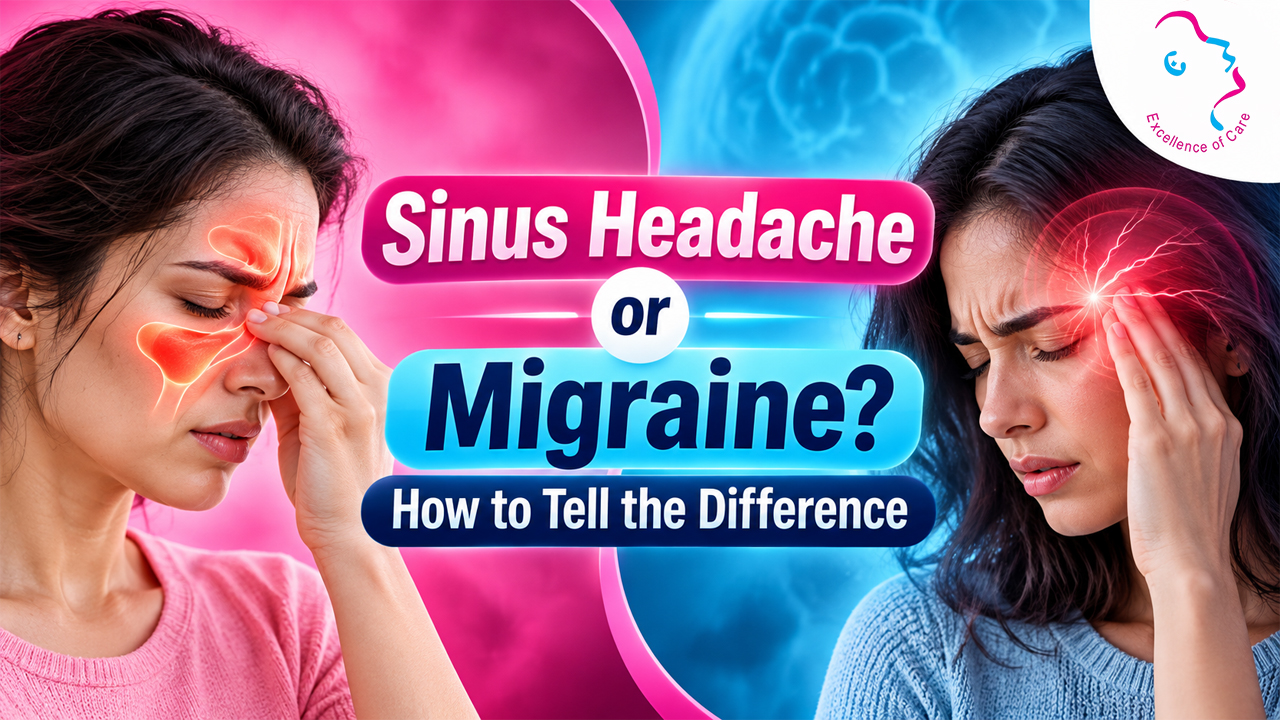
You wake up with a headache, pressure around your forehead, and discomfort near your eyes. Your nose feels blocked, and bending forward makes the pain more noticeable. You might immediately assume that you have a sinus headache. But could it actually be a migraine?
Distinguishing sinus headache or migraine is not always straightforward because both can cause facial discomfort, pressure around the eyes, and even nasal congestion.
The main difference is the underlying cause. A true sinus-related headache is associated with inflammation or infection of the sinuses, whereas migraine is a neurological disorder that can affect how the brain processes pain and sensory information.
If you experience nausea, sensitivity to light or sound, or headaches that interfere with your daily activities, migraine may be more likely. If headache occurs alongside prominent nasal symptoms, reduced smell, and a recent respiratory infection, sinusitis may be a possibility.
However, symptoms overlap, and neither condition can be diagnosed from one symptom alone.
According to the American Migraine Foundation's guide to sinus headache and migraine, many headaches that people identify as sinus-related are actually migraine attacks.
Understanding the differences can help you recognize when to seek medical advice, avoid unnecessary treatments, and choose the appropriate specialist.
Sinus Headache vs Migraine: What Is the Main Difference?
A sinus headache and migraine can produce pain in similar areas, but their associated symptoms and underlying mechanisms differ.
A true sinus-related headache occurs when inflammation of the nasal passages and sinuses is responsible for the pain. This is commonly associated with a condition called rhinosinusitis.
Migraine, on the other hand, is a neurological condition that can cause recurring attacks of moderate to severe headache, nausea, sensitivity to light or sound, and other symptoms.
The International Headache Society's diagnostic criteria for headache attributed to acute rhinosinusitis emphasize that evidence of sinus inflammation and a relationship between the sinus condition and headache are needed to support the diagnosis.
Sinus Headache or Migraine: Symptoms Comparison
| Feature | Sinus-related headache | Migraine |
|---|---|---|
| Underlying cause | Rhinosinusitis or another relevant sinus condition | Neurological headache disorder |
| Pain location | Forehead, cheeks, around the eyes, sometimes upper teeth | One or both sides of the head, forehead, temples, or face |
| Pain quality | Often facial pressure or aching | Often throbbing or pulsating, but may vary |
| Nasal congestion | Common with sinusitis | Can occur during migraine |
| Nasal discharge | May be prominent; can become thick | May be clear or watery |
| Reduced sense of smell | Can occur | Not a defining feature |
| Nausea or vomiting | Not typical of uncomplicated sinusitis | Common |
| Sensitivity to light or sound | Less characteristic | Common |
| Fever | May accompany an infection | Not typical of migraine itself |
| Effect of movement | Facial pressure can be noticeable when bending | Routine physical activity often worsens the headache |
| Symptom pattern | Often occurs with an upper-respiratory illness | Recurrent attacks, often with recognizable accompanying symptoms |
This comparison highlights patterns rather than absolute rules. A person may have migraine and sinusitis at the same time, or another condition may be responsible for the pain.
What Is a Sinus Headache?
The sinuses are air-filled spaces located around the nose, forehead, cheeks, and eyes. They connect with the nasal cavity through small drainage pathways.
The lining of the sinuses produces mucus that normally drains into the nose.
When this lining becomes inflamed, swelling may interfere with drainage and contribute to congestion, pressure, and discomfort.
Inflammation involving the nasal passages and sinuses is called rhinosinusitis, often shortened to sinusitis.
Common sinus headache symptoms
A headache associated with rhinosinusitis may occur with:
Facial pressure around the cheeks, forehead, or eyes
Persistent nasal blockage
Runny nose or thick nasal discharge
Reduced sense of smell
Post-nasal drip
Discomfort in the upper teeth
Cough or throat irritation
Fever during some infections
The CDC's information about sinus infection symptoms identifies nasal congestion, facial pain, headache, post-nasal drip, and other respiratory symptoms as possible features.
However, facial pressure alone is insufficient to diagnose sinusitis.
What causes sinus-related headaches?
Viral respiratory infections
A common cold can cause swelling of the nose and sinus lining. This may temporarily block normal drainage and produce facial pressure.
Many acute sinus infections are viral and improve without antibiotics.
Bacterial sinus infections
Bacterial rhinosinusitis is less common than viral infection.
A bacterial cause becomes more concerning when symptoms are persistent without improvement, become significantly worse after initially improving, or involve severe symptoms in an appropriate clinical pattern.
The color of nasal mucus alone cannot confirm bacterial infection.
Allergic rhinitis
Allergies can cause nasal congestion, sneezing, itching, and watery eyes. These symptoms may coexist with facial discomfort or sinus inflammation.
Allergy symptoms can also occur in people with migraine, making the distinction more confusing.
Chronic or recurring sinus conditions
Some individuals experience long-lasting nasal blockage, inflammation, nasal polyps, or repeated sinus symptoms.
These conditions may require a more detailed examination to determine whether sinus disease explains the headache.
For more information, read ENT Care Centre's article on sinusitis vs common cold and their key symptoms.
What Is a Migraine?
Migraine is more than an ordinary headache. It is a neurological disorder characterized by recurring attacks that may involve head pain and a range of sensory, digestive, and neurological symptoms.
A migraine attack may last several hours or longer. Some people experience attacks occasionally, while others have frequent episodes that significantly affect work, sleep, family life, and daily activities.
Common migraine symptoms
Migraine symptoms may include:
Moderate to severe headache
Throbbing or pulsating pain
Pain on one or both sides of the head
Nausea or vomiting
Sensitivity to bright light
Increased sensitivity to sound or smells
Pain that worsens during normal physical activity
Fatigue and difficulty concentrating
According to the NHS guidance on migraine symptoms and treatment, migraine attacks commonly last between four hours and three days, although individual experiences vary.
Migraine with aura
Some people experience a neurological warning phase known as aura.
Aura can involve temporary visual disturbances, such as flashing lights, zigzag patterns, or blind spots. It may also cause tingling sensations or difficulty with speech.
Not everyone with migraine experiences aura.
New, unusual, or persistent neurological symptoms must not automatically be assumed to be migraine. Sudden weakness, speech difficulty, or vision loss requires emergency assessment.
What can trigger migraine?
Migraine triggers vary among individuals. Commonly reported triggers include changes in sleep, stress, missed meals, dehydration, hormonal fluctuations, and certain sensory exposures.
Weather changes may also be associated with migraine attacks in some people.
A useful distinction is that a trigger is not necessarily the underlying cause of the disorder.
For example, someone may notice headaches after a weather change and assume that sinus pressure must be responsible. But weather-related symptoms can also be associated with migraine.
Tracking headache patterns can help identify possible triggers without assuming that every association proves causation.
Why Is Migraine Often Mistaken for a Sinus Headache?
The biggest source of confusion is that migraine can produce symptoms that feel remarkably similar to sinus problems.
Many people believe that a headache occurring near the nose, cheeks, or forehead must be caused by sinus inflammation.
However, the location of pain does not always reveal its source.
Migraine can cause nasal congestion
During migraine attacks, changes involving the autonomic nervous system can contribute to symptoms such as a blocked nose, runny nose, watery eyes, or facial pressure.
The nerves involved in migraine also carry sensation from regions around the eyes, nose, sinuses, and face.
Consequently, migraine pain may feel as though it comes directly from the sinuses.
The Mayo Clinic explanation of sinus headaches describes how sinusitis and migraine symptoms can overlap.
What does clinical research suggest?
The American Migraine Foundation discusses research involving nearly 3,000 people who reported recurring sinus headaches but had not previously received a migraine diagnosis or treatment.
In that selected study population, 88% were found to have migraine.
This finding helps explain why repeated self-treatment for supposed sinus headaches may not solve the underlying problem.
However, the figure should not be interpreted to mean that every person with sinus pressure has migraine, or that the same percentage necessarily applies to patients in Nepal.
Can you have sinusitis and migraine together?
Yes. The conditions are not mutually exclusive.
A person with migraine may also develop a common cold, allergic rhinitis, or sinus infection.
Nasal inflammation can sometimes aggravate an existing headache disorder.
A healthcare professional may need to evaluate both conditions rather than assuming that one diagnosis explains every symptom.
Five Questions That Can Help You Understand Your Headache
These questions can help organize your symptoms before a medical appointment. They are not a substitute for a professional diagnosis.
1. Do you feel nauseated or sensitive to light?
Nausea, vomiting, and sensitivity to light or sound are particularly useful clues for migraine.
They are less typical of uncomplicated sinusitis.
2. Do you have prominent nasal symptoms?
Persistent congestion, reduced smell, and nasal discharge occurring together during a respiratory illness can support evaluation for rhinosinusitis.
A blocked nose alone is not enough because migraine and allergies can also cause congestion.
3. Did your headache start during a cold?
A headache that begins alongside significant nasal symptoms and changes as the respiratory illness improves or worsens may be related to sinus inflammation.
If headaches repeatedly occur without a clear respiratory illness, another headache disorder should be considered.
4. Does normal movement make the pain worse?
Migraine pain often becomes more troublesome during ordinary activity, such as walking or climbing stairs.
Both migraine and sinus-related discomfort may feel worse when bending forward, so bending-related pressure should not be used as a reliable standalone test.
5. Do your headaches occur in repeated attacks?
Headaches that recur in a recognizable pattern, particularly with nausea, light sensitivity, or substantial activity limitation, warrant assessment for migraine.
A headache diary can record attack duration, associated symptoms, possible triggers, medicines taken, and how symptoms affect daily activities.
The goal is not to label yourself but to provide useful information for the clinician.
Could It Be an Allergy, Tension Headache, or Another Condition?
Sinusitis and migraine are not the only possible causes of discomfort around the forehead, eyes, or face.
Allergic rhinitis
Allergic rhinitis commonly produces sneezing, nasal itching, runny nose, watery eyes, and nasal congestion.
Exposure to dust, pollen, or other allergens may worsen symptoms.
Allergy can coexist with migraine and may complicate the clinical picture.
When nasal symptoms persist or recur, allergy testing and treatment in Kathmandu may help clarify whether allergic rhinitis is contributing to the problem.
Tension-type headache
Tension-type headache commonly causes a pressing or tightening sensation across both sides of the head.
It is generally not accompanied by the prominent nausea and light sensitivity often associated with migraine.
Dental, eye, and other causes
Problems involving the upper teeth, jaw, or eyes can sometimes produce pain that seems to originate near the sinuses.
Certain less common headache disorders can also affect the area around one eye or one side of the face.
This is why a reliable diagnosis should consider the full symptom pattern rather than pain location alone.
How Do Doctors Diagnose Sinus Headache or Migraine?
Diagnosis usually begins with a detailed clinical history.
A clinician may ask when the headache started, where it hurts, how long it lasts, whether nausea or light sensitivity occurs, and whether nasal symptoms are present.
Previous episodes, medicines, medical conditions, and neurological symptoms also matter.
ENT examination
If persistent congestion, nasal discharge, reduced smell, or recurring sinus symptoms are prominent, an ear, nose, and throat examination may help identify a nasal or sinus condition.
An ENT specialist may examine the nasal cavity and related structures for signs of inflammation, obstruction, or other abnormalities.
Is nasal endoscopy necessary?
Sometimes, but not for everyone.
Nasal endoscopy allows an ENT specialist to inspect areas inside the nose and around sinus openings using a small camera.
It may be considered for persistent or recurrent symptoms, suspected nasal polyps, or unexplained nasal obstruction.
ENT Care Centre explains its approach on its nasal endoscopy for sinus and nasal symptoms page.
An endoscopy finding must be interpreted together with symptoms and examination findings. It does not automatically establish the cause of a headache.
Does everyone need a CT scan?
No.
CT imaging is not routinely necessary for uncomplicated acute sinusitis or typical migraine.
A doctor may consider imaging when symptoms suggest complications, unusual disease, chronic sinus problems, or another cause requiring investigation.
Headache associated with genuine rhinosinusitis requires a convincing clinical relationship between the sinus disease and the pain. Merely finding a sinus abnormality on imaging does not always explain the headache.
When should a neurologist be involved?
A neurologist or appropriate headache specialist may be helpful when migraine is suspected, headaches occur frequently, treatment is not working, or the diagnosis remains uncertain.
An ENT specialist may also advise neurological evaluation if nasal or sinus findings do not adequately explain the symptoms.
Sinus Headache Treatment: What Helps?
Treatment depends on the cause.
A headache related to viral sinusitis should not be managed in the same way as migraine, and neither condition should automatically lead to antibiotics or sinus surgery.
Managing viral sinusitis
Many uncomplicated acute sinus infections improve with time and supportive care.
Depending on the individual, a clinician may recommend appropriate pain relief, rest, hydration, and measures to ease nasal congestion.
The CDC's sinus infection treatment guidance explains that many sinus infections improve without antibiotics.
Safe saline nasal rinsing
Saline nasal rinsing may help remove mucus and provide temporary relief from nasal symptoms in suitable patients.
Use a clean device and water that is sterile, distilled, or previously boiled and cooled.
Never use untreated tap water directly for nasal rinsing.
The CDC's recommendations for safe sinus rinsing explain the water-safety precautions.
Patients with special medical circumstances should ask a healthcare professional whether nasal irrigation is suitable.
When are antibiotics needed?
Antibiotics do not treat migraine and are not appropriate for most viral sinus infections.
A clinician may consider bacterial rhinosinusitis when symptoms persist without improvement, worsen after initial recovery, or are accompanied by a concerning combination of fever, nasal symptoms, and significant pain.
Even when bacterial infection is suspected, the decision to prescribe antibiotics depends on severity, risk factors, and clinical guidance.
The NICE recommendations for acute sinusitis treatment advise against routinely prescribing antibiotics during the early course of uncomplicated acute sinusitis.
Taking antibiotics without a proper indication can expose patients to side effects and contribute to antimicrobial resistance.
Managing recurring sinus problems
Persistent or recurrent sinus symptoms may require assessment for allergy, chronic rhinosinusitis, nasal polyps, or structural nasal problems.
Treatment may involve appropriate medicines, nasal-care guidance, allergy management, follow-up, or selected procedures.
For patients seeking Sinus treatment in Nepal, the important first step is to determine whether the headache is actually related to a sinus condition.
ENT Care Centre provides sinus treatment in Kathmandu for persistent and recurring nasal symptoms, including assessment of sinusitis, nasal blockage, allergy-related conditions, and nasal polyps.
Migraine Treatment: Why the Approach Is Different
Migraine treatment focuses on managing attacks, improving function, and reducing future attacks where appropriate.
Treatments for sinus congestion cannot reliably manage an underlying migraine disorder.
Treatment during a migraine attack
A healthcare professional may recommend suitable pain-relieving medicines, migraine-specific medicines, or medicines for nausea.
Migraine-specific treatments may include triptans or other therapies, depending on the patient's medical history and clinical needs.
Not every medicine is suitable for everyone. Cardiovascular conditions, pregnancy, other prescriptions, age, and previous treatment response may influence the choice.
Preventing frequent migraine attacks
When attacks occur frequently or significantly disrupt daily life, preventive treatment may be considered.
Options can include prescription medicines, management of contributing factors, and appropriate behavioral or lifestyle strategies.
Regular meals, consistent sleep, adequate hydration, and a headache diary may support management.
Some people benefit from identifying and avoiding individual triggers, although avoiding every possible trigger is neither necessary nor realistic.
Avoid taking painkillers too frequently
Frequent use of headache-relief medicines can contribute to medication-overuse headache.
If you regularly need pain medicine for headaches, seek professional advice rather than repeatedly increasing the amount you take.
A suitable migraine treatment plan should be based on the diagnosis, frequency of attacks, associated symptoms, and medical history.
When Is a Headache an Emergency?
Most headaches are not life-threatening. Nevertheless, some symptoms require immediate medical assessment.
Go to an appropriate hospital emergency department if you develop:
A sudden, extremely severe headache that reaches maximum intensity rapidly
New weakness, numbness, difficulty speaking, or confusion
Loss of vision or other sudden major visual changes
Headache with high fever and a stiff neck
A seizure or altered consciousness
Severe headache following significant head injury
Severe sinus symptoms with swelling around an eye, double vision, or reduced vision
These warning signs may indicate conditions that require urgent treatment and should not be dismissed as routine migraine or sinusitis.
The NICE guidance on headache assessment and NHS headache emergency advice provide additional information about these red flags.
An attack lasting longer than usual, a change from your established headache pattern, or a new headache during pregnancy also warrants prompt medical advice.
When Should You Visit an ENT Clinic in Kathmandu?
If you experience recurring facial pressure, persistent nasal congestion, reduced smell, or repeated sinus symptoms, an ENT assessment can help identify whether nasal or sinus disease is contributing.
For someone searching for an ENT clinic in Kathmandu, the relevant question is whether the provider can examine the suspected nasal condition and explain when a different specialist is more appropriate.
An ENT examination is especially relevant when nasal symptoms are prominent or persistent.
However, if repeated attacks mainly involve nausea, sensitivity to light, and disabling headache without convincing sinus inflammation, migraine assessment through an appropriate medical professional may be more useful.
People sometimes search for an ENT hospital when facial pain is severe. The choice between a specialist clinic and a hospital should depend on symptom severity, diagnostic needs, and whether emergency care is required.
ENT Care Centre in Kathmandu
ENT Care Centre provides specialist evaluation for ear, nose, throat, sinus, allergy, and related conditions.
Its clinic is located on Madan Bhandari Road, Kathmandu 44600, Nepal.
Patients with persistent nasal or suspected sinus symptoms can learn about its ENT specialist consultation service in Kathmandu.
If the clinical assessment does not explain recurring headaches through sinus disease, appropriate assessment for migraine or another headache disorder may be necessary.
For routine appointments, you can request an ENT consultation online or contact ENT Care Centre for appointment information.
Clinic phone: 01-4790229.
Contact the clinic to confirm the current appointment schedule and availability of the appropriate specialist.
Frequently Asked Questions
Can migraine cause a blocked nose?
Yes. Some people experience nasal congestion, a runny nose, or watery eyes during migraine attacks. These symptoms do not automatically indicate sinusitis.
Can a sinus infection trigger migraine?
A respiratory illness or nasal inflammation may coincide with or aggravate migraine in susceptible individuals. It is also possible to experience sinusitis and migraine at the same time.
Why does my headache become worse when I bend forward?
Both sinus-related discomfort and migraine can worsen when bending forward. This symptom alone cannot reliably distinguish the two conditions.
Does green or yellow mucus always mean bacterial sinusitis?
No. Mucus color alone cannot establish bacterial infection. Doctors consider duration, severity, progression, and other clinical findings.
Can migraine cause pain behind the eyes?
Yes. Migraine can cause discomfort around the eyes or forehead. However, sudden visual changes, a painful red eye, or other unusual eye symptoms require prompt medical assessment.
How long does a sinus headache last?
When pain is genuinely caused by acute rhinosinusitis, its duration often follows the underlying illness. Acute sinusitis may take two to three weeks to settle. Persistent or worsening symptoms should be assessed professionally.
Should I visit an ENT specialist or neurologist?
An ENT specialist is appropriate when persistent nasal and sinus symptoms are prominent. A neurologist or headache specialist may be more suitable for recurring headaches with migraine features. A clinician can help determine the correct referral.
Conclusion: Sinus Headache or Migraine — Getting the Right Diagnosis Matters
A headache around the forehead, cheeks, or eyes does not necessarily mean you have a sinus infection.
Migraine can produce facial pressure, nasal congestion, and other symptoms that resemble sinusitis. Conversely, a genuine sinus infection may cause headache along with nasal blockage, discharge, reduced smell, and other respiratory symptoms.
The most useful clues are the overall symptom pattern, associated symptoms, timing, and clinical examination.
If your symptoms are persistent, recurrent, or affecting daily activities, professional evaluation can help identify the cause and guide appropriate care.
For ongoing nasal congestion, facial pressure, or suspected sinus problems in Kathmandu, book an ENT assessment at ENT Care Centre to discuss suitable next steps.
If the headache has emergency warning signs, seek immediate hospital care rather than waiting for a clinic appointment.